

The IT asset disposition (ITAD) industry moves more than $20 billion in end-of-life enterprise hardware every year. A retired server can recover between 5% and 35% of its original cost, highlighting the potential for value even after its primary use. That is money most providers leave on the table, because they treat a depreciating server as a sunk cost and run it until it dies.
This is the financial engine of hardware lifecycle management, the discipline that decides when a machine has earned its keep. Master the curve, and you refresh on the cheap while staying ahead on performance. Ignore it, and you pay full price for gear already halfway to worthless. DedicatedCore and DomainRacer built their cost advantage on getting this one model right.
Server Asset Value and Depreciation: When to Refresh and When to Sell
Depreciation is not an accounting abstraction. It is the real, falling market price of a machine, and it follows a predictable shape. Residual value is what the asset is worth at the end of a set period; resale value is what the market pays for it today. The gap between them is where money is won or lost.
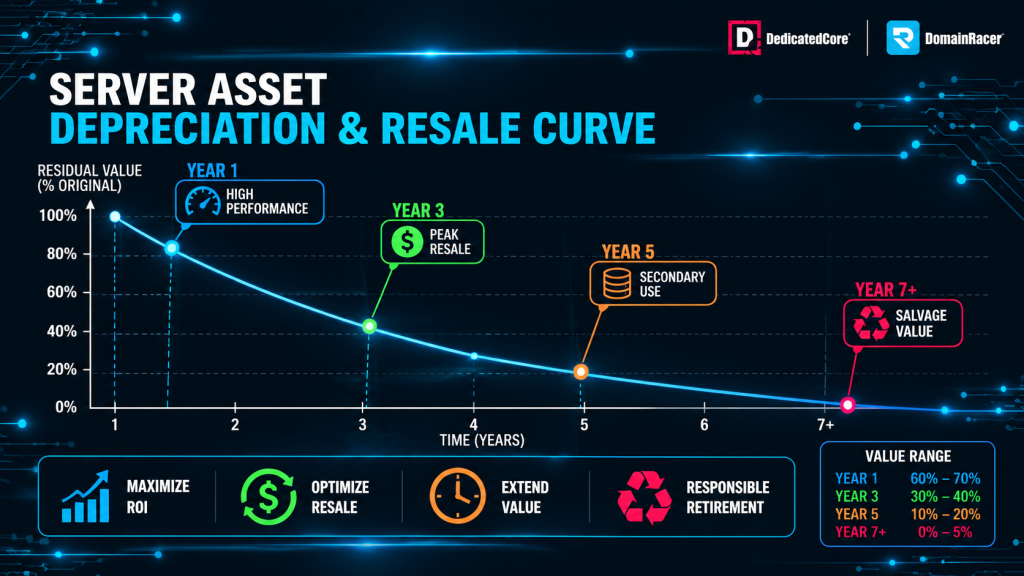
Server Asset Depreciation & Resale Curve
| Server age | Residual value | Market condition | What we do here |
| 1 year | 60 to 70% of new | Strong demand, current generation | Run it hard in frontline roles |
| 2 years | 45 to 55% | Healthy, still-current platform | Full production, value still climbing on the books |
| 3 years | 30 to 40% | The classic refresh window | Sell latency-critical nodes into peak demand |
| 5 years | 10 to 20% | Thin demand, nearing EOSL | Cascade to workloads that don’t need new silicon |
| 7 years+ | Salvage or scrap | Legacy, outdated, component value only | Harvest component value, then prepare for decommissioning |
A used server sold at year three returns about a third of its price. The same machine held to year six returns almost nothing and burns extra power the whole way down. We map every asset against this curve the day it is racked and sold into demand, not after it.
Ask any host when they last modelled their fleet’s depreciation. If the answer is never, they are guessing at the one number that should drive every hardware decision they make.
Server Asset Value and Depreciation Driven by Age, Demand, and Condition
Two servers of the same age can be worth very different amounts, because value does not fall with time alone. It falls with the things time brings, and each one is a lever we watch.
- Newer generations ship. A faster CPU or denser platform launches, and last year’s flagship is repriced overnight.
- Warranty and support lapse. A bare-metal machine that is past its warranty and End-of-Service-Life (EOSL) is worth much less. The buyer gets unsupported firmware and hard-to-find parts.
- Condition and history. A well-maintained server with clean logs commands a premium. A neglected one is priced as a gamble.
- Efficiency falls behind. Older hardware consumes more power for the same work, and software licensing tied to aging platforms adds costs. So, running expenses climb even as prices drop.
That third lever is one we control directly. We have a full preventive maintenance program. This means our retired hardware has a documented service history. This history increases the machine’s value from scrap price to real resale value. Maintenance is not just uptime insurance. It is resale insurance.
Accounting Life vs Technical Life: Two Lifecycles That Shape Server Value
Here is the distinction most operators miss, and the one our whole model turns on. A server has two lifespans, and they do not end at the same time.
- Accounting life is how long the finance department depreciates the asset on paper, often three or five years by policy.
- Technical life is how long the machine can actually do useful work, which is frequently far longer.
A server fully depreciated but still capable is pure leverage: it owes nothing, yet it still produces. Its real cost is a Total Cost of Ownership (TCO) question, not an age one, so we play both lifespans at once. For businesses planning their next infrastructure investment, DedicatedCore dedicated servers are an option to consider when dedicated computing resources are a priority:
- Run the written-down years. A well-kept vintage machine maintains an impressive 99.99% uptime, far beyond its expected paper life. It still operates under a full hardware replacement SLA because we actively maintain it. This diligent care allows it to be cascaded into roles that do not require new silicon.
- Sell what is truly spent. Gear at the end of its technical life goes while it still fetches a price, letting old stock fund the new.
Owning the fleet, rather than reselling it, is what makes that cycle possible.
DedicatedCore’s Server Refresh Strategy for Maximizing Server Asset Value
The central question in fleet economics is how often to refresh. Refresh too early, and you waste capital on hardware that still has years left. Refresh too late, and you bleed money on power, maintenance, and lost performance. Each cycle length is a different bet.
- 3-year refresh suits peak-performance, latency-critical workloads. Highest capital cost, but the strongest resale value.
- 5-year refresh is the balanced default for most fleets. Moderate cost, solid residual return.
- 7-year refresh fits cost-first, stable workloads. Lowest capital cost, but higher power draw and failure risk.
There is no single right answer, and that is the point. A blanket policy across a whole fleet is where money leaks. We refresh by role, not by calendar. Latency-sensitive nodes have a strong resale value in a tight three-year cycle, while stable workhorses can last up to seven years when the economics support it. Traders who need a hosting environment for latency-sensitive workloads can also consider DedicatedCore Forex VPS when comparing their infrastructure options. This is where replacement timing and depreciation become one decision, not two.
Server Asset Management Through Continuous Hardware Renewal
Every provider owns hardware. The difference is whether anyone runs the numbers behind it.
| What decides fleet economics | Typical budget host | Average managed host | DedicatedCore / DomainRacer |
| Depreciation tracking | None | Rough book value | Modelled per asset, per curve |
| Refresh timing | Run to failure | Fixed calendar policy | Timed by role against the curve |
| Written-down hardware | Scrapped or ignored | Retired on schedule | Redeployed across its technical life |
| Resale | Sold raw, late | Occasional, unplanned | Sold into demand, offsets the refresh |
| What you pay for | Full price, every cycle | Some recovery | A fleet that part-funds its own renewal |
That bottom row is the whole advantage. A budget host pays full price every cycle, while we run a model where each machine part-funds the one that replaces it.
The Financial Impact of One-Year Refresh Delay on Server Asset Value
Holding hardware past its window feels like saving money. It is usually the opposite, and the cost hides in three places at once.
- Rising running costs. Older servers draw more power for the same output, and consolidating onto modern hardware can cut CPU energy costs by up to 65%.
- Collapsing resale value. Every year of delay drops the machine further down the curve, so the sale that could have offset a refresh returns less and less.
- Climbing failure risk. Ageing hardware fails more often, and each unplanned outage carries its own steep cost.
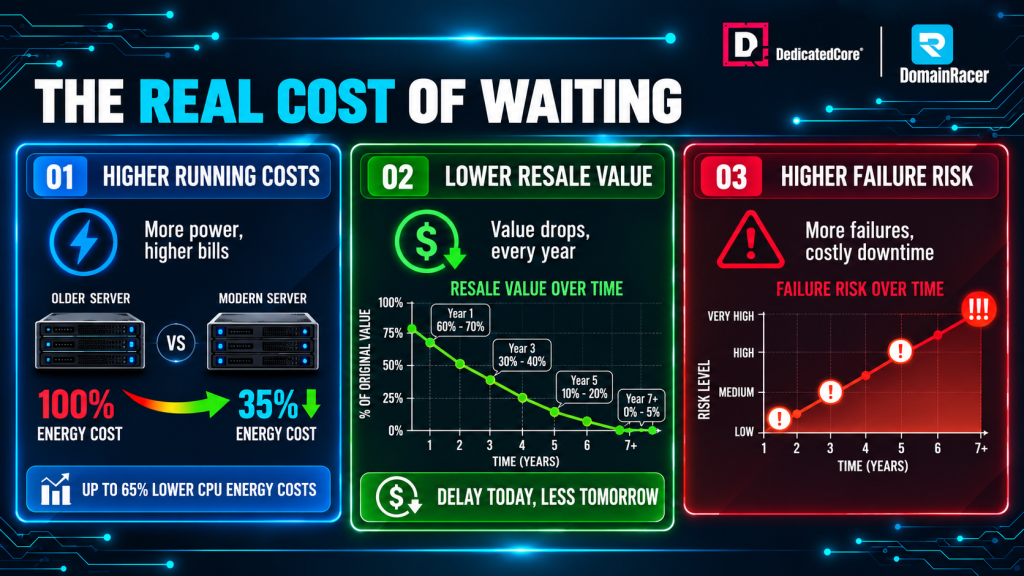
The Real Cost of Waiting
Stack the three together, and a one-year delay is rarely a saving. It is a deferred bill with interest, paid in power, lost resale, and downtime. We model this cost for every asset approaching its window. The honest number almost always argues for acting on time rather than hoping for one more quiet year. This approach emphasizes the importance of timely action to avoid potential losses.
Server Asset Management for Better ROI from Refurbished and New Servers
Buying refurbished and selling existing hardware are two sides of the same model, and the choice is never ideological. It is arithmetic.
- Refurbished, recertified, and reconditioned hardware from one generation back offers great performance. It costs much less, making it perfect for tasks that don’t require the latest tech. A pre-owned platform bought well on the second-hand market can outperform a budget-new box at the same spend.
- New hardware justifies its cost when it offers real efficiency or capability. This is often true in roles that need high performance or are ready for AI. For traders comparing hosting solutions, DomainRacer Forex VPS is another option to evaluate based on their trading platform requirements and preferred server location.
The ROI of a refresh is simple to frame. The gain is lower power, higher density, better performance, and recovered resale. The cost is the new hardware minus what the old fleet returns. We run that calculation per role, which is why our refreshes pay for themselves faster than a blanket buy.
A refurbished node bought cheap, run in the right role, and sold before it hits the salvage floor earns across its whole life, not just the middle of it.
Server Asset Management Business Outcomes Through Two Depreciation Success Stories
Our case studies show how effective server asset management can reduce replacement costs and recover value from existing hardware. These examples highlight the financial benefits of making informed refresh decisions.
Case Study 1: A refresh that funded itself.
A SaaS company had 40 servers that hit the five-year mark, fully depreciated but starting to show their age. The company assumed a refresh would mean a big capital cost, and since the hardware still worked, the finance team only saw the cost of replacing it.
Our Solution: DedicatedCore tracked each server’s depreciation. We sold the fleet in year five, while the resale market was still strong, before values dropped. The recovered capital was rolled straight into modern, energy-efficient replacements.
The Result: Resale covered much of the refresh costs. Power use dropped significantly with the new hardware. The company also switched to a current platform at a much lower price, enhancing overall efficiency.
Case Study 2: Two lifespans, one fleet.
A growing platform was about to retire a rack of three-year-old servers on a strict accounting schedule, ready to buy all-new to replace them. The machines were fully depreciated but technically sound.
Our Solution: DomainRacer split the fleet by role. The recorded servers shifted to tasks that didn’t require top performance. New hardware went where speed truly mattered. Nothing was retired before its technical life was spent.
The Result: The client received a key performance upgrade. It maintained robust hardware for key functions and cut its planned hardware costs significantly.
DedicatedCore’s Expert Answers to Server Asset Management Questions
At DedicatedCore, we answer common server asset management questions based on our technical knowledge and experience. Here are our expert insights to help you make informed decisions about hardware value, depreciation, and replacement timing.
When is the best time to sell old server hardware?
We sell into demand, not after it, which for most enterprise hardware means the three-year window. That’s where a machine has lost most of its value but still sits on a strong, appealing platform that buyers want. Wait much longer, and the resale market thins fast as the hardware nears its support cliff.
The exact timing shifts with the platform and the market, so we model each asset rather than applying a blanket date. The principle remains the same: selling a server while buyers still want it covers its replacement cost. However, keeping a server until it’s worthless brings little return and increases running costs.
Is it worth buying refurbished servers instead of new?
For a great many workloads, yes, and we run plenty of recertified hardware ourselves for exactly that reason. A machine from the last generation, tested and with the right firmware, offers great performance at a lower price. This is perfect for tasks that don’t require cutting-edge technology.
New hardware wins when its premium makes sense. This often happens in performance-critical or AI-ready roles. In these cases, the latest efficiency pays for itself. The trap is treating it as all-or-nothing. The real saving comes from matching each role to the right class of hardware, new where it counts and refurbished where it does not.
Why does a maintained server sell for more?
Because the buyer is pricing risk, and a documented service history removes most of it. To maximize server resale value, proof is key. A machine with clean maintenance logs, verified firmware, and a known lifespan is reliable. This reliability means it sells for more than an identical server without any records.
Preventive maintenance helps keep servers running and protects their resale value. Proper server decommissioning also provides proof of the server’s condition and value when selling it. Parts that cannot be resold are recovered for their component value or responsibly recycled instead of being dumped.
Turn Server Asset Management into a Long-Term Business Advantage
A server has one life, and every stage of it decides what the next one costs. We spot the wear early, maintain the machine so it stays healthy and holds its value, time its replacement against the curve instead of the calendar, keep it running with spare parts on the shelf, and retire it cleanly with its value recovered and its data gone. That is the whole of hardware lifecycle management, and depreciation is the thread that ties it to money.
Every provider buys the same hardware. The difference is that DedicatedCore and DomainRacer run it as a model, not a bill. Old stock is sold at the right moment to help fund the new, so the fleet stays modern without the modern price. That is the quiet reason one quote comes in lower than another for the very same machine, and it is the difference you are actually choosing between. Pick the host that runs the model, not the one who only sends the bill.

