

Cloudflare stopped 47.1 million DDoS attacks in 2025. That is more than double the year before, and network-layer attacks alone tripled to 34.4 million. It works out to 5,376 attacks every hour, so the question is no longer whether your servers get targeted.
Prevention is the phase nobody funds until after the first outage. Every control in this guide is cheap while the network is quiet. The same protection costs far more once the traffic arrives. DedicatedCore and DomainRacer treat prevention as the cheapest stage in the defense cycle. A server that meets its first flood unprepared is usually a budget decision made a year earlier.
DedicatedCore’s DDoS Attack Prevention Process: From Risk Assessment to Incident Recovery
Prevention fails because teams buy mitigation and skip the work that makes it function. Defense runs in three phases, and each one depends on the phase before it:
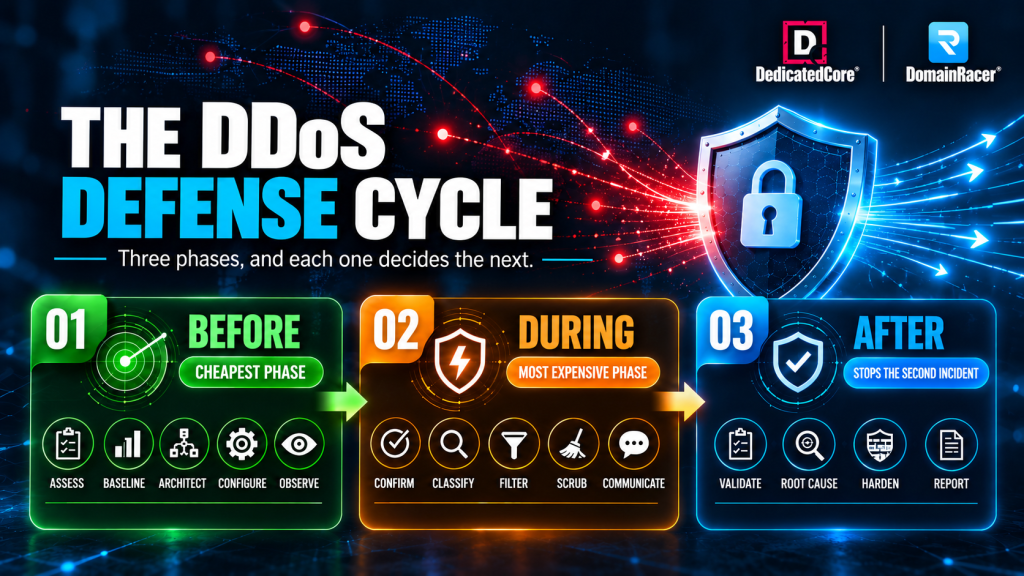
The three phases of DDoS defense: prevention, active mitigation, and post-attack recovery.
- Before — assess, baseline, architect, configure, observe. Cheap, and it decides everything else.
- During — detect, classify, filter, scrub, communicate. Expensive, and shaped by the phase above.
- After — validate, analyse, harden, report. This is what stops the second incident.
We run all three as one cycle, so every incident feeds the next round of hardening. Most hosts only run the middle phase, which is why their second attack looks exactly like their first. Ask your current host for their time-to-mitigate figure, because if they cannot give you a number, they never measured one.
DDoS Protection and Mitigation Standards for Server Infrastructure
Every host on the market claims DDoS protection. The difference shows up in the first ten minutes.
| What decides survival | Typical budget host | Average managed host | DedicatedCore / DomainRacer |
| Protection type | Null-route the victim IP | On-demand, manual trigger | Always-on filtering, upstream scrubbing |
| Response trigger | Customer opens a ticket | Monitoring alerts staff | Automated at the network edge |
| Time-to-mitigate | Hours, or never | 30–60 minutes | Under 30 seconds |
| Scrubbing capacity | None, upstream only | Shared, undisclosed | Published in Gbps and Mpps |
| Layer 7 coverage | None | Basic WAF | Tuned WAF, per-endpoint limits |
| Hardware ceiling | Often past EOSL | Not measured | Current-generation NICs, Tier IV |
| Post-incident report | None | Verbal | Written, per event |
| What you are left with | An offline server | An apology | A service that stayed up |
That first row is the whole product. A budget host stops the attack by taking you off the internet, which is the attacker’s goal in friendlier words. We keep real traffic flowing and filter the rest upstream.
Part 1: DDoS Attack Preparation and Prevention Before an Incident
Everything in this phase is cheap while the network is quiet, and unavailable the moment traffic arrives. These are the controls that decide whether the next two phases are a routine filter or a full outage.
DDoS Attack Risk Assessment and Infrastructure Readiness Planning
Generic threat data will not help you here. A regional retailer and a forex broker face different attackers, different methods, and very different attack sizes.
- Size the threat against your vertical. Finance, gaming, and crypto draw the biggest floods. Forex platforms get hit during volatile hours because timing is the product.
- Find what breaks first. For most stacks, it is not bandwidth. It is a connection table, a database pool, or a worker queue.
- Price an hour of downtime. Count revenue, SLA credits, support load, and churn. Without that number, every security conversation stalls at “it seems expensive.”
- Name the decision-maker. Someone has to approve a null route or emergency scrubbing. If nobody is named, your response time includes finding them.
Write your realistic worst case down in Gbps and Mpps, because everything in the capacity section depends on it. Most hosts never ask what vertical you are in. They sell the same package to a hobby blog and a trading platform. For traders who need infrastructure suited to automated trading workloads, DedicatedCore Forex VPS provides a hosting option to evaluate alongside network stability and DDoS protection requirements.
DDoS Attack Surface Mapping and Origin Server IP Protection
Your attack surface is every address and endpoint a stranger can reach. Most operators underestimate it. The gap is nearly always an origin server behind a CDN that no longer hides it.
Four things leak that real address into public view:
- Old DNS records — whatever your domain pointed to before the CDN went in.
- Mail headers — outbound mail from the origin publishes its address in every message.
- Certificate logs — forgotten subdomains that resolve straight to the server.
- Error pages — applications that print internal hostnames when something breaks.
We rotate the origin address after any CDN deployment, because the old one already sits in public databases. That single step defeats the most common bypass method there is, and almost nobody does it. Say your host moved you behind a CDN and kept the old address. An attacker walks around that protection in ten minutes.
DDoS Traffic Baseline Establishment for Accurate Attack Detection
Every detection tool you buy is worthless without a baseline. This is the step almost everyone skips, and it explains why their alerts get ignored within a month.
- Collect a minimum of 30 days, recorded per hour. Tuesday at 3 AM and Friday at 8 PM are completely different traffic.
- Track bandwidth, packet rate, connections, and errors together, because the combination names the attack.
- Capture shape, not just volume — country mix, mobile ratio, GET-to-POST ratio.
- Refresh it quarterly. Traffic drifts, and a stale baseline throws false alarms that train your team to ignore them.
We hold a 30-day hourly profile for every customer, which is why classification takes seconds instead of guesswork. Most hosts alert on a fixed threshold instead. That fires during your busiest legitimate hour and stays silent through a small-packet flood.
DDoS Attack Infrastructure Planning and Anycast Network Architecture
The architecture decision happens long before any attack, and it sets how much filtering you will ever need. A single-origin setup blocks at one point, so the pipe becomes your ceiling. Anycast announces the same address from many locations, so a 400 Gbps attack against twenty sites becomes twenty 20 Gbps problems.
Anycast spreads attacks across multiple locations instead of blocking them. This helped absorb the record floods in our DDoS attack case study collection. We use it for both brands. DedicatedCore serves enterprises and global regions, while DomainRacer focuses on India and APAC.
DDoS Attack Protection Through CDN Deployment and Origin IP Security
A CDN is the cheapest volumetric absorption available, as long as the origin behind it is genuinely hidden.
- Cache aggressively. Every cached response is a request your origin never sees.
- Firewall the origin to CDN ranges only. Your server should refuse packets from anywhere else.
- Route mail separately. Outbound mail from the origin address undoes all of the above.
A CDN will not stop application-layer attacks against uncacheable pages. Search, login, and checkout reach your origin by design; the WAF and rate-limiting sections handle that. A host that sells you a CDN and calls it DDoS protection has covered the easy half. The expensive half stays with you.
Firewall Configuration for DDoS Attack Protection and High Packet Rates
Firewall rules only survive contact if you tune them for flood conditions instead of ordinary traffic.
- Default-deny inbound. Open only what you need. Servers exposing database ports break this rule constantly.
- Enable SYN cookies. Half-open connections stop eating memory, which is the whole mechanism of a SYN flood.
- Raise the conntrack limit to match your RAM, and the hash table size with it. A full connection table drops real traffic just as well as any attack.
- Rate-limit new connections per source before the application ever sees them.
- Prefer nftables over iptables at high packet rates. Set handling is faster once your block list runs to thousands of entries.
One honest caution belongs in this section. A server firewall burns CPU on the machine under attack. It handles small floods and volumetric ones not at all. Those packets have already arrived and already used your bandwidth. Volume has to die upstream. Any provider calling a server firewall their DDoS answer is describing a tool for a different problem.
WAF Deployment and Rule Tuning for Application Layer DDoS Protection
A web application firewall catches what the network layer cannot see. Layer 7 attacks look like ordinary requests, and they drain your application rather than your pipe.
- Start in monitoring mode and review what the rules would have blocked over two weeks of real traffic.
- Switch to blocking only after tuning, because a WAF that blocks checkout costs more than the attack it stopped.
- Weight rules toward expensive pages — search, login, and anything hitting the database uncached.
- Track the false positive rate as a metric, not an afterthought.
We run every rule set in monitoring mode before it blocks anything. That two-week delay is the step most hosts skip. They ship default rules on day one, and the first thing those rules break is usually a payment flow.
Rate Limiting Strategies for Preventing and Mitigating DDoS Attacks
Rate limiting is the highest-value control in this guide, and it costs almost nothing.
- Set limits per endpoint. Login might allow five attempts a minute. A product page might allow sixty.
- Limit by the right key. Per-IP breaks for mobile users, where a whole network can share one address.
- Return 429 with Retry-After. Well-behaved clients back off on their own, which cuts load at no enforcement cost.
One global limit is either too loose to help or too tight to be safe. A global limit is exactly what most control panels give you. We key limits on sessions and API keys as well as addresses, so we are limiting behaviour instead of infrastructure.
DDoS Attack Monitoring and Flow Data Collection for Network Protection
Bandwidth graphs miss packet-rate attacks completely, so flow data has to be your foundation.
- Collect NetFlow, sFlow, or IPFIX from your routers for packet rate, source spread, and protocol mix.
- Alert on bandwidth and packet rate separately, because the two fail independently.
- Track conntrack use, which climbs while every other metric looks healthy.
- Watch application response time, since Layer 7 attacks show up nowhere else.
We alert on all four separately. This data helps us find interface problems early and supports our preventive maintenance. Many hosts collect packet data but do not alert on it, so they only learn about small-packet attacks from customer complaints.
Capacity Planning and the Hardware Ceiling Most Providers Ignore
Buying more scrubbing capacity does nothing if your edge hardware caps out first. This is where DDoS defense stops being only a software question. Businesses evaluating infrastructure for demanding workloads should consider DedicatedCore dedicated servers alongside network capacity, packet-processing limits, and upstream mitigation capabilities.
We size protection using Absorption Headroom Ratio:
Effective AHR = min(Scrubbing capacity, Hardware packet-rate ceiling) ÷ Peak attack for your vertical
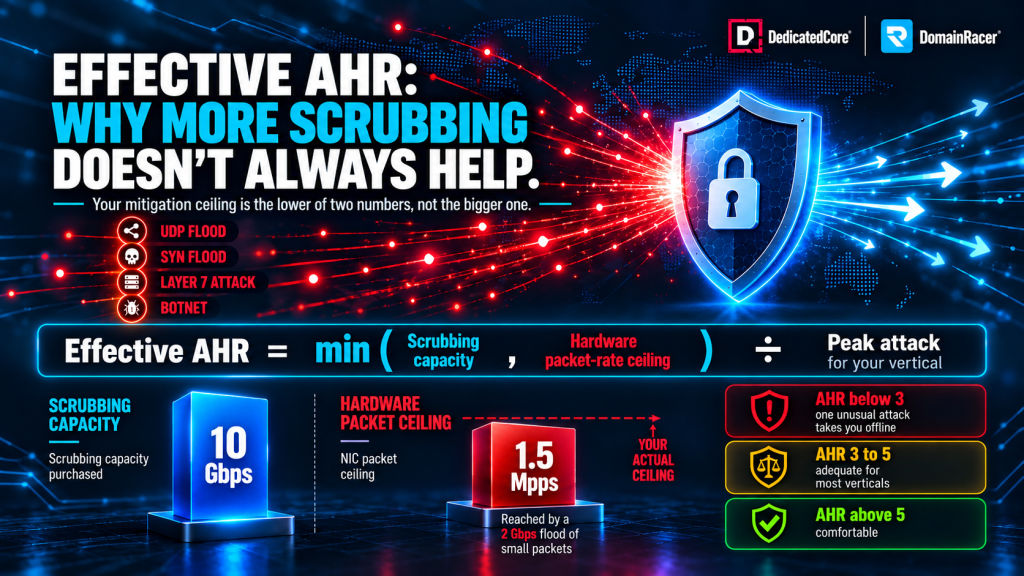
Effective DDoS mitigation depends on both scrubbing capacity and the hardware packet-rate ceiling.
Below 3 means that one unusual attack can take you offline, while above 5 is comfortable for most verticals. The hardware half is what competitors leave out:
- NIC packet ceiling — unrelated to rated bandwidth, so a 2 Gbps attack of tiny packets can saturate a 10 Gbps port.
- Conntrack scales with RAM — less memory means faster state exhaustion.
- Past end-of-service-life — no more firmware or offload fixes, and the ceiling drops every year.
An ageing card lowers your Effective AHR no matter how much scrubbing you bought, and your invoice will never mention it. Catching that decline before it costs you an outage is a hardware risk problem as much as a security one.
DDoS Attack Mitigation Through BGP Routing and Upstream Scrubbing
BGP is where serious mitigation actually happens, and where hosting providers either earn their money or quietly show they cannot.
- Black hole routing (RTBH) — upstream drops all traffic to one address. Blunt, since that address goes dark, but it protects everything else you run.
- BGP redirection — you announce your prefix to a scrubbing provider, and clean traffic returns over a tunnel. The more useful tool of the two.
Time-to-mitigation depends on preparation. Tested tunnels can activate in minutes, while new tunnels can take an hour. We test our scrubbing paths regularly so they are ready during an attack.
Part Two: DDoS Attack Detection, Mitigation, and Response During an Active Attack
Every option available in this phase was decided in Part One, and the only variable left is how fast you use them. Most hosts start their process here, which is why their first ten minutes go on finding out what they should already have known.
DDoS Attack Confirmation Based on Traffic Patterns and Baseline Analysis
First, we check if the traffic is really an attack. A product launch, viral post, or client retry loop can look similar. We compare the traffic with our baseline.
Real traffic has varied locations and user agents, reflecting normal browsing behavior. However, attacks often show unusual patterns that differ from typical user activity. We do not increase filtering when the evidence is unclear, and the commands are covered in the detection guide.
DDoS Attack Classification and Vector Identification Under Pressure
Different attacks die at different layers of the stack. Classify one wrongly, and you filter hard while going down anyway.
- Volumetric — amplification through exposed DNS, NTP, or memcached servers. Fills bandwidth, and no botnet is needed, only a reflector list.
- Protocol — SYN and fragmented floods that exhaust state tables. High Mpps, low Gbps, and the reason packet rate matters most here.
- Application-layer — valid HTTP against expensive pages. Smallest in volume, hardest to stop, invisible to scrubbing.
- Multi-vector — all three, often in sequence, forcing you to hold several layers at once.
Each one broke a record when it first appeared. Our DDoS attack case study collection shows how quickly the industry adapted. We can classify attacks in seconds because we already have a baseline. Without one, it can take much longer.
Traffic Filtering and the Legitimate Traffic Trade-Off During an Attack
Every aggressive filter carries some risk of blocking legitimate users. No vendor advertises this, and it is the most important thing to understand about mitigation.
- Escalate in stages, starting with the narrowest rule that helps.
- Watch conversion, not traffic graphs. The graph looks excellent when you are blocking everyone.
- Set a reversion time on emergency rules, or they quietly suppress real traffic for weeks.
Aggressive filtering is right during a severe flood, because losing some real traffic beats losing all of it. It is wrong during a marginal event, where you have created an outage for paying customers to stop an attack that was never going to work. A false positive at checkout costs more than the attack it prevented, and that timing is set out minute by minute in the incident response SOP.
DDoS Attack Mitigation Through Upstream Scrubbing and Traffic Redirection
When edge filtering is not enough, the traffic has to be cleaned before it reaches you. You announce your prefix, the scrubbing provider filters it, and clean traffic comes back over a tunnel.
- Always-on scrubbing — traffic already passes through the filter, so mitigation takes seconds.
- On-demand redirection — measured in minutes, driven by BGP convergence and by how fast someone decides to trigger it.
The human decision is often the biggest delay, so a tested process matters more than better technology. Ours runs always-on across both brands, so filtering happens before traffic reaches the server.
DDoS Attack Rate Limiting Adjustments During an Active Attack
Limits set in peacetime are tuned for normal traffic. Under attack, they need tightening to a plan, not by instinct.
- Drop limits on targeted pages only. Global tightening punishes users who are not part of the problem.
- Shift the limiting key if the attack rotates addresses, moving to session or fingerprint limiting.
- Log every change with a timestamp, because post-incident analysis is impossible without it.
- Set a reversion time before you make the change, not after the attack ends.
We log every mid-incident rule change automatically. Hosts that adjust limits by hand cannot tell you afterward what they changed, and that makes the root cause analysis a work of fiction.
Customer Communication and Status Page Management During DDoS Attacks
Host the status page somewhere other than the infrastructure under attack. Publishing outage notices on servers that are down is a common and entirely avoidable failure.
- Say what is affected, that you are working on it, and when the next update lands.
- Do not guess at the cause. Early attributions are usually wrong and get quoted back to you.
- Do not promise a fix time. You do not control the attacker’s schedule.
- Do not go quiet. A holding update with nothing new still beats an empty page.
We send the first alert before the attack is fully classified. More details can follow later. We keep the message ready in advance, so no one has to write it under pressure.
DDoS Mitigation Monitoring and Effectiveness During Active Filtering
Mitigation without measurement is only guesswork. Four numbers matter while filtering runs.
- Attack traffic dropped versus passed — is the filter catching the actual vector?
- False positive rate — how much real traffic is dying alongside it.
- Application response time — the number that tells you whether customers are being served.
- Signature drift — multi-vector attacks change shape, and your filter has to follow.
Most hosts watch only the first of those. That is how an incident gets declared resolved while conversion sits at zero.
Part 3: DDoS Attack Recovery and Post-Incident Hardening
The attack is over, and nobody is watching, which is exactly when the next one gets set up. This phase turns a survived incident into a closed one, and it is the phase most hosts skip entirely.
DDoS Attack Recovery and Post-Mitigation Service Validation
Traffic returning to normal is not the same as recovery. Attacks stop and restart, and attackers watch how fast you drop your defenses.
- Verify from outside your network, across several regions. Internal checks pass while external users still fail.
- Check application function, not connectivity. A server that answers pings with a drained database pool has not recovered.
- Remove mitigation gradually, in reverse order of severity.
- Inspect the hardware. Interfaces stressed at high packet rates can show error counters and degraded links.
A card that survived the attack in a degraded state is a scheduled failure, not a solved problem. How fast it gets swapped comes down to your replacement SLA and whether the part is already on the shelf. Most hosts never look, and the same card fails properly three weeks later.
DDoS Attack Root Cause Analysis and Mitigation Debt Assessment
Root cause analysis asks why the attack succeeded, not what the attack was. The vector itself is rarely the interesting answer.
The interesting answers usually sound like this. The origin address sat exposed in an old DNS record. Detection took nineteen minutes because the alert went to a channel nobody watches. The scrubbing tunnel was configured but never tested. Conntrack limits were still at distribution defaults.
Every one of those is Mitigation Debt coming due. We keep the review blameless. If people fear it, you get half the story, and the same incident repeats next quarter.
DDoS Attack Infrastructure Hardening and Effective AHR Recalculation
- Turn every finding into a change with an owner and a date. Vague promises to improve monitoring produce nothing.
- Recalculate Effective AHR against the attack you just absorbed, while the budget conversation is still easy.
- Re-baseline, because the attack shifted your traffic patterns and your thresholds should follow.
- Re-test anything used in anger before you trust it again.
We run through this list after every incident. A host that hardens nothing afterward has told you exactly what happens during the next one.
DDoS Attack Documentation, Reporting and Regulatory Compliance After an Incident
Different audiences need different documents, and mixing them serves no one. Executives need impact, duration, cost, and what changes. Customers need acknowledgment, scope, and a commitment to prevent recurrence. Internal teams need the full technical timeline.
Indian organizations should note that CERT-In requires them to report certain incidents within six hours of detection. That window is tighter than most teams plan for. Build it into the process rather than discovering it mid-incident.
We issue a written report after every event. Most hosts offer a phone call, which leaves you nothing to show a regulator or a board.
Post-DDoS Attack Documentation and Lessons Learned for Infrastructure Resilience
An incident that produces no documentation gets repeated in full, usually by a different person making the same call.
- Record the timeline with real timestamps, including detection lag and time-to-mitigate.
- Record what did not work, which is more useful than what did.
- Update the runbook while memory is still accurate.
- Close the loop with the customer, because the follow-up report decides whether they renew.
We treat the post-incident report as a deliverable rather than a courtesy. The executive and root cause templates are already written. Nobody starts from a blank page at the worst possible moment.
DDoS Prevention Outcomes Through Our Real-World Examples
Our case studies show how DDoS prevention helps protect critical services during attacks. These examples highlight how timely mitigation can keep trading platforms available when businesses need them most.
Case Study 1 — A forex broker survives a market-hours attack.
A trading platform took a multi-vector attack during peak session hours. A minute of unreachable execution costs clients real money. Their previous host had responded to a similar event by null-routing the address, which took the platform fully offline.
Our solution: We deployed DomainRacer Forex VPS with an infrastructure strategy built around traffic distribution and upstream filtering. Anycast spread the heavy traffic across multiple locations, while upstream scrubbing handled the protocol layer. We also used session-key rate limiting on the order API instead of per-IP limits because the attack kept changing IP addresses.
The Result: Trading continued through the attack. The volumetric component was the distraction, and the Layer 7 component was the real threat.
Case Study 2 — An e-commerce platform closes an origin exposure.
A retailer behind a CDN kept going down despite paying for edge protection. The attacks were bypassing the CDN completely, so the protection they bought had never applied to the traffic that mattered.
Our Solution: We traced the leak to old DNS records and outbound mail headers. We rotated the origin address, firewalled it to accept CDN ranges only, and moved mail to a separate address.
The Result: The bypass attacks stopped completely. R Edge protection they were already paying for finally covered all their traffic.
Both cases turned on work done before the attack rather than during it. Anycast, session-key limiting, and origin hiding are all key provisioning choices. You can’t add them during an incident.
DedicatedCore’s Expert Answers to DDoS Prevention Questions
At DedicatedCore, we answer common questions about DDoS prevention based on our technical knowledge and experience. Here are our expert insights to help you understand the limits of prevention and how layered protection reduces the risk of service disruption.
Can DDoS attacks be prevented completely?
We tell customers no, and any provider promising otherwise is selling something. Anyone can send packets to a public address. The largest recorded attacks exceed capacity that almost no organisation could justify buying.
The goal is to absorb attacks at scale. A well-protected server can handle attack traffic without affecting the customer. This depends on three things: enough mitigation capacity, fast detection, and a tested response. Attacks then become routine traffic instead of major events.
Does a CDN alone protect my dedicated server?
Partly, and the gap is where most CDN-protected sites still go down. A CDN absorbs volumetric attacks against cached content very well. Traffic terminates across an edge network far larger than any single origin.
The failure point is origin exposure. Find the real address behind a CDN and the whole edge layer becomes decorative. Old DNS records and mail headers leak those addresses constantly. A CDN also does little against application-layer attacks aimed at uncacheable pages. Closing both gaps needs the origin firewalled to CDN ranges and rate limits at the application layer. Your CDN vendor will not do that work.
How much DDoS protection does my server actually need?
We start with your vertical rather than a generic number. Finance, gaming, and crypto platforms face far larger attacks than typical business sites. Forex infrastructure draws targeted attacks during volatile hours, because that is when the damage lands.
Then we apply the Effective AHR formula. That is mitigation capacity divided by your vertical’s worst case, using the lower of scrubbing and hardware ceiling. Below 3 means one unusual attack takes you offline. The calculation usually shows the real constraint is packet-rate handling, not raw bandwidth. That changes what you buy and what you ask your current host.
Building Stronger Infrastructure for DDoS Attack Protection
DDoS prevention gets funded after the first outage, which is exactly the wrong order. Every control here is cheap while the network is quiet, and the same protection costs far more once traffic arrives. That gap between the two prices is Mitigation Debt in one sentence. This guide works with our DDoS attack case study collection, the detection guide, and the incident response SOP. Together, they show whether your provider was prepared before the traffic arrived.
The choice is simple. Choose a provider that shares its time-to-mitigate, packet-rate capacity, and filters traffic before you ask. DedicatedCore and DomainRacer provide always-on mitigation in Tier IV facilities, with hardware built for Mpps and Gbps, plus a 30-day trial and no setup fees. Prepare while the network is quiet, because downtime comes at a higher cost.

