

The public record for DDoS attacks jumped from 3.8 Tbps in late 2024 to 31.4 Tbps in November 2025, an eightfold rise in roughly fourteen months. That record-setting attack lasted only 35 seconds. Cloudflare detected and stopped it automatically, and traced it back to the Aisuru-Kimwolf botnet.
Every entry below either set a public record or forced a permanent change in how malicious traffic is separated from real users. DedicatedCore and DomainRacer built our defense stack around these lessons. Each attack exposed a gap that stayed invisible until someone exploited it. The vectors are all public knowledge. The only variable is whether your provider adapted.
DDoS Attack Measurement: Understanding Tbps, Bpps and RPS
DDoS attacks are not measured on one scale, so a single ranked list would mislead you. Three separate units are in use, and an attack can break a record in one while looking unremarkable in the others.
- Tbps — bandwidth that fills the network pipe, the headline number and the least useful one on its own.
- Bpps — packets per second that exhaust Layer 3/4 resources, where network cards and state tables fail while bandwidth still looks fine.
- RPS — requests per second that exhaust Layer 7 resources, where workers are used up by traffic a WAF must inspect rather than block.
Entries below are ranked by size, because that is how records get reported. Size ranking misses two key players that impacted the industry. In 2016, Dyn hit about 1.2 Tbps, taking many platforms offline by attacking their shared DNS provider. In 2013, Spamhaus reached around 300 Gbps, prompting a global cleanup of open resolvers.
Largest DDoS Attacks in History and Their Record-Breaking Scale
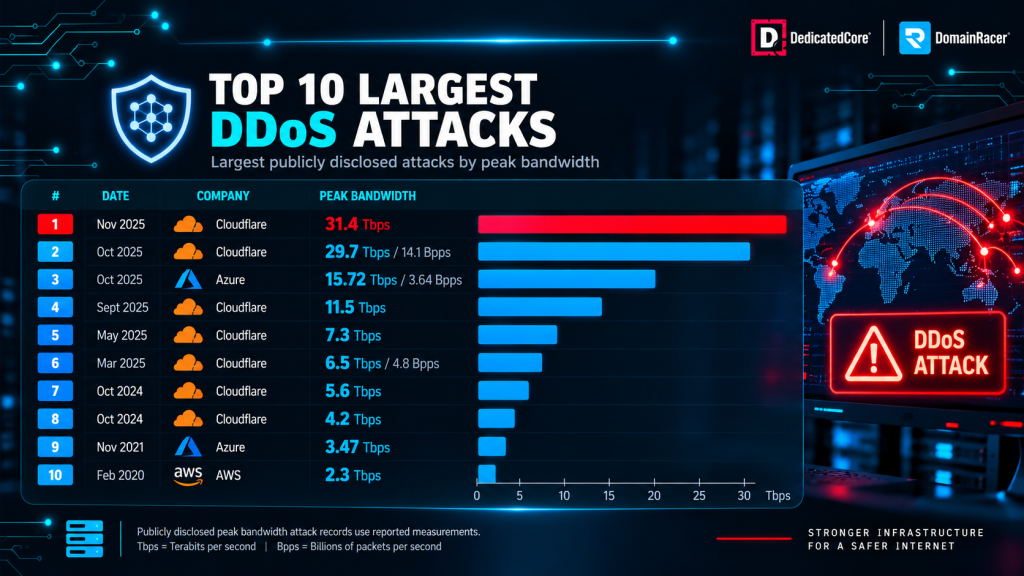
A comparison of publicly disclosed DDoS attacks by reported peak bandwidth.
| Rank | Date | Target | Peak | Record class | Vector |
| 1 | Nov 2025 | Cloudflare customer | 31.4 Tbps | Current record | Aisuru-Kimwolf botnet |
| 2 | Oct 2025 | Cloudflare customer | 29.7 Tbps / 14.1 Bpps | Bandwidth + packet | Aisuru botnet |
| 3 | Oct 2025 | Azure customer (Australia) | 15.72 Tbps / 3.64 Bpps | Cloud record | Aisuru UDP flood |
| 4 | Sept 2025 | Cloudflare customer | 11.5 Tbps/ 5.1 Bpps | Bandwidth | UDP flood, IoT and cloud |
| 5 | May 2025 | Cloudflare customer | 7.3 Tbps | Bandwidth | UDP flood |
| 6 | Q1 2025 | Cloudflare customer | 6.5 Tbps / 4.8 Bpps | Bandwidth + packet | Hyper-volumetric flood |
| 7 | Oct 2024 | Cloudflare customer | 5.6 Tbps | Bandwidth | Mirai-variant UDP flood |
| 8 | Oct 2024 | Cloudflare customer | 4.2 Tbps | Bandwidth | UDP flood |
| 9 | Nov 2021 | Azure customer | 3.47 Tbps | Bandwidth | ~10,000 sources, 10+ countries |
| 10 | Feb 2020 | AWS customer | 2.3 Tbps | Bandwidth | CLDAP reflection |
In October 2023, Google mitigated an attack peaking at 398 million requests per second using HTTP/2 Rapid Reset. Its bandwidth was unremarkable, which is why it sits nowhere in the table above. Cancelling HTTP/2 streams costs the server far more than the attacker, so a bandwidth graph during that attack would have looked close to normal.
Every attack type above is now handled by standard filtering, and our prevention guide shows the controls that stop each one. Most hosts treat this timeline as marketing history, but we treat it as a list of methods that have already worked.
Major DDoS Attacks, Infrastructure Failures, and Their Business Impact
| Rank | Attack | Why it worked | Business impact | Our control today |
| 1 | Nov 2025 Cloudflare | Over in 35 seconds | Manual response would have missed it entirely | Always-on filtering |
| 2 | Oct 2025 Cloudflare | 1–4M infected Android TVs and routers | Hyper-volumetric became routine, not exceptional | Source reputation treated as a weak signal |
| 3 | Oct 2025 Azure | 500,000+ source IPs, single endpoint | Largest cloud attack ever recorded | Capacity sized by Effective AHR |
| 4 | Sept 2025 Cloudflare | 35-second burst | Appliance-based defense rendered obsolete | Always-on, never trigger-based |
| 5 | May 2025 Cloudflare | 12% above the previous record in weeks | Records now break in months, not years | Headroom provisioned above current peaks |
| 6 | Q1 2025 Cloudflare | 4.8 Bpps packet rate alongside the volume | Packet rate became the harder problem | Mpps alerted separately from bandwidth |
| 7 | Oct 2024 Cloudflare | Record broken three times that year | Set the floor for automated response | Automated edge mitigation |
| 8 | Oct 2024 Cloudflare | Short bursts under a minute | Ticket-based response stopped working | Detection at the network edge |
| 9 | Nov 2021 Azure | Distributed across 10+ countries | Geographic blocking proved useless | Behavioural filtering, not IP reputation |
| 10 | Feb 2020 AWS | Unmodelled protocol, ran for days | Absorbed, but responders exhausted | Defined shift rotation for long incidents |
Read the last column as its own timeline. Each control appears only after an attack shows that the earlier method didn’t work. None of them were invented in advance; a host that cannot link its defenses to the incidents that caused them is using tools built by someone else.
The Common Patterns Behind Record-Breaking DDoS Attacks
Ten record-breaking attacks, four recurring patterns.
- New vectors beat prepared defenses. Every record came from a method nobody had modelled. Capacity is what survives the unknown vector.
- Duration is falling as size rises. From weeks in the early 2010s to 35 seconds in 2025. Response models built on human decision-making have already expired.
- Packet rate matters more than bandwidth. Recent records carry Bpps figures alongside the terabits. Packet rate exhausts NICs and state tables, and most buyers never ask about it.
- Most victims were collateral. The Dyn attack took down dozens of companies nobody targeted. Dependency exposure is attack surface you do not control.
The third pattern is where hosting decisions go wrong. An old network card past its end-of-service life handles fewer packets and no longer receives performance fixes. Your ability to absorb attacks seems to decline each year, while the bill stays the same. Most providers cannot tell you their packet-handling limit because nobody ever measured it.
DDoS Protection Standards and Attack Response Across Hosting Providers
| What decides survival | Typical budget host | Average managed host | DedicatedCore / DomainRacer |
| Response trigger | Customer opens a ticket | Monitoring alerts staff | Automated at the network edge |
| Time-to-mitigate | Hours, or never | 30–60 minutes | Under 30 seconds |
| Sub-minute burst attacks | Missed entirely | Missed entirely | Mitigated before completion |
| Mpps provisioning | Not measured | Not disclosed | Provisioned and published |
| Layer 7 coverage | None | Basic WAF | Tuned WAF, per-endpoint rate limits |
| Hardware ceiling | Often past EOSL | Not measured | Current-generation NICs, Tier IV |
| Post-incident reporting | None | Verbal | Written report per event |
The first row settles it. Against a 35-second attack, any process that begins with a human being is a process that finishes after the outage. What the first sixty minutes should actually look like is set out in the incident response SOP.
DDoS Incident Response Through Our Real-World Case Studies
Drawn from our operational history across both brands. Customer identities are anonymised.
Case Study 1 — The 2012 Incident: reflection flood against a 10 Gbps uplink.
Customer: An e-commerce hosting cluster running on a 10 Gbps uplink, with no dedicated mitigation and no traffic baseline in place.
Attack: Around 65 Gbps of NTP and DNS reflection traffic, spoofed at the source so it arrived from legitimate resolvers around the world. Against a 10 Gbps port, the pipe filled long before the server struggled.
Detection: Interface counters showed the uplink was full. Customers noticed timeouts before we did. Without a baseline, we had nothing to measure the spike against.
Mitigation: Local filtering was useless once the uplink was full, so we dropped the reflected UDP source ports at the transit edge. Clean traffic came back gradually as the filters tightened.
Lesson: Reflection filtering is now done upstream all the time. Baseline collection is also required before any customer goes live. Detection lag cost more than the attack size ever did, and the signals we watch from day one are covered in the detection guide.
Case Study 2 — The 2017 Incident: hybrid flood against a FinTech API gateway.
Customer: A FinTech API gateway handles authenticated transaction traffic. In this setup, the speed of requests directly affects the times for settlement.
Attack: Roughly 250 Gbps and 45 Mpps combined, arriving as two attacks at once. A SYN flood targeted connection state while an HTTP POST flood hit the login endpoint, where every request triggered a database write.
Detection: Flow data caught the packet-rate spike before bandwidth moved at all. Connection tracking increased steadily, but throughput remained flat. This suggests a protocol attack instead of a volumetric one.
Mitigation: SYN cookies and higher conntrack limits managed the protocol layer. Upstream scrubbing took care of the volume. After the POST flood, we rotated addresses often. This caused per-IP limiting to fail. So, we switched to session-key limiting and adjusted it until real logins were no longer affected.
Lesson: The volumetric traffic was a distraction, and the POST flood was the attack that mattered. Session-key rate limiting became standard on every authenticated endpoint afterward.
Case Study 3 — The 2026 Incident: hyper-volumetric burst against a crypto exchange.
Customer: A crypto exchange where trade speed is everything, and even a few seconds of downtime costs clients money.
Attack: Around 12.8 Tbps and 4.2 Bpps delivered in short bursts, using QUIC and HTTP/3 flooding. The traffic matched Aisuru-Kimwolf-class attacks, and the packet rate was high enough to damage the hardware.
Detection: Automated at the network edge, with no human involved before mitigation was already running. A burst this short is invisible to any response that starts with a ticket.
Mitigation: Always-on filtering absorbed the burst while anycast spread the load. No manual action was needed.
Lesson: Outcomes in this class come down to one thing, which is whether mitigation runs always-on or waits for a trigger. Provisioning against Bpps rather than Tbps is what held the line.
Fourteen years separate the first case from the third, and the pattern reverses completely across them. In 2012, the customer noticed before our monitoring did, while in 2026 they only learned about the attack from our report. Nothing about the attacks got easier in that time, and preparation did all of the work.
DedicatedCore’s Expert Answers to DDoS Attack History Questions
These three come up after every major attack makes the news, usually from traders and operators who saw the headline and want to know what it means for their own setup.
Does a record-breaking attack mean my server is next?
Record attacks land on infrastructure large enough to absorb and disclose them. What actually hits a dedicated server is usually between 100 Mbps and a few Gbps, which never makes the headlines but takes an unprotected server offline for hours.
We size protection against your vertical rather than the record, because a forex platform and a regional retailer face very different attackers. Cheap DDoS-for-hire services put a multi-gigabit attack within reach for less than the price of a meal, so what decides your outcome is whether mitigation starts without a support ticket. Traders comparing options can consider DomainRacer Forex VPS based on their trading requirements and the protection included.
Why does the 35-second attack change what I should ask a host?
Because it separates marketing from architecture. Most hosts describe DDoS protection as something triggered after detection, which means a ticket, an engineer, and a filter applied. In a 35-second burst, a time-to-mitigate measured in minutes is a figure recorded after the outage is already over.
Ours runs always-on, so filtering sits in the traffic path before anything arrives. Traders evaluating their setup can consider DedicatedCore Forex VPS alongside the provider’s mitigation approach. Ask your current host one question: does mitigation activate automatically, or does someone have to trigger it?
Why do you talk about packet rate when everyone else sells bandwidth?
Because packet rate is what actually kills hardware, and almost nobody quotes it. A network card has a packets-per-second ceiling unrelated to its rated bandwidth, so a 2 Gbps attack of tiny packets can saturate a 10 Gbps port while the bandwidth graph looks healthy.
Ageing network cards make this worse by missing driver and offload updates, which is where hardware risk meets DDoS defence. For workloads needing reliable hardware capacity, DedicatedCore dedicated servers offer infrastructure to consider alongside DDoS protection.
Turn DDoS Attack Lessons Into Always-On Protection
Every attack in this timeline exposed a gap that looked theoretical right up until someone exploited it. Open resolvers, default memcached bindings, a protocol behaving exactly as specified. None exotic, and all fixable in advance for a fraction of what the outage cost. That is Mitigation Debt written across a decade of public record. Preparation rather than capacity separated the ten-minute mitigations from the multi-hour outages. This history opens a sequence that continues through the detection guide, the prevention guide, and the incident response SOP.
The choice is clear. Pick a provider who shows how fast they stop an attack, lists their packet capacity, and filters traffic without you asking. DedicatedCore and DomainRacer run always-on mitigation in Tier IV facilities, on hardware provisioned for Bpps as well as Tbps. The trial runs for 30 days with no setup fees. Pick the defense that was already running, because the attack you plan for is never the one that arrives.
