
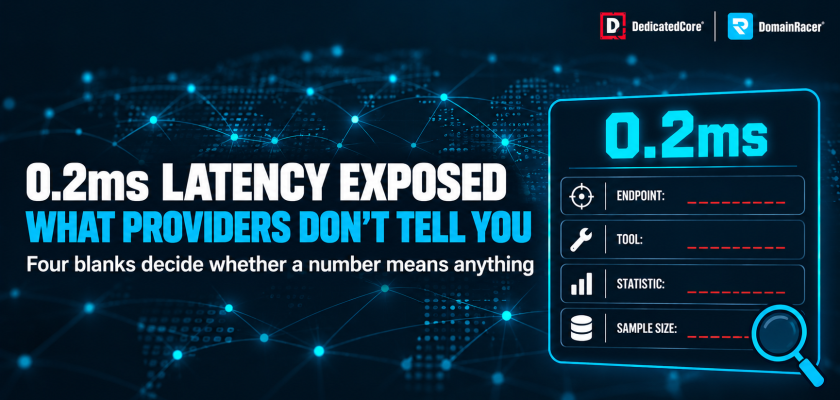
Most traders search for the lowest Forex VPS latency, only to ask one question: Is 0.2 ms latency real? Yes, it is possible under the right conditions. Light travels fast enough, and a direct cable between two racks in the same data centre can achieve such speeds. The real problem is not whether 0.2 ms is possible, but whether the provider can prove that the figure applies to your broker’s trading server.
There is one explanation as to why the standard test fails. Juniper router restricts ping messages to 1,000 packets per second. The reasoning is that ping is considered traffic that could saturate the router. So your ping isn’t being treated the same way as your real orders. Before accepting an unverified sub-millisecond figure, traders can use a latency claim evidence review to examine the basis of the advertised figure. DedicatedCore and DomainRacer share the exact endpoint, tool, and numbers behind every figure we give you. A number no one can check isn’t a real measurement — it’s just a claim.
Forex VPS Latency Claims: Why Advertised Figures Are Hard to Verify
The number is usually real. It is the context that goes missing, and without context you cannot tell a good measurement from a flattering one.
- The endpoint is unnamed. Measured to a gateway in the same building, or to your broker’s trading server? Those are different numbers.
- The tool is unnamed. ICMP ping and a TCP connect test give different answers on the same route.
- The statistic is unnamed. The best sample ever recorded, or the one order in a hundred that goes worst?
- The sample size is unnamed. One test at 3 am, or continuous measurement through an open session?
Four blanks, and every one of them can be filled to make a number look better. We fill them in public, because the alternative is asking you to take our word for it.
Forex VPS Latency Claims Compared Across Providers
Every host quotes a figure. The difference is whether anything sits behind it.
| What decides the number | Typical budget host | Average managed host | DedicatedCore / DomainRacer |
| Endpoint named | No | Vaguely | Broker’s trading server, stated |
| Tool named | No | ICMP implied | TCP connect, ICMP secondary |
| Statistic named | Best result | Average | p50, p95, p99 |
| Sample size | One test | Occasional | Continuous, session-aware |
| Jitter published | Never | No | Yes |
| Packet loss published | Never | No | Yes |
| Test IP for you | Not offered | On request | Provided at signup |
| What you are left with | A headline | An estimate | A number you can check |
That last row is the whole product. Anyone can publish a number. Very few will hand you the means to test it.
The Physics Behind Sub-Millisecond Forex VPS Latency Claims
Start with what physics actually allows. Ignoring those limits will immediately undermine your credibility with technical readers.
- Light in fibre covers roughly 200 kilometres per millisecond. That is the hard floor for any distance.
- A cross-connect inside one hall is well under 0.1ms. Two racks, one cable, no routing.
- Equinix publishes 4ms from Slough to Frankfurt and around 30ms to New York. Those are real distances with real floors.
- Every hop adds time. Switches, routers, and peering points each cost microseconds that add up, and so does an ageing network card, which is a hardware risk question rather than a routing one.
A 0.2 to 0.5 ms latency is possible between two machines in the same building using a direct connection. But that is not practical for an overseas broker. A VPS reaches the broker over a network, adding latency. For workloads needing greater control over physical resources, DedicatedCore dedicated servers are another infrastructure option to assess. When assessing whether hardware control matches a strategy’s demands, traders can consult an audit of infrastructure shortfalls to understand the consequences of infrastructure gaps.
9 Ways to Check Whether a Forex VPS Latency Claim Holds Up
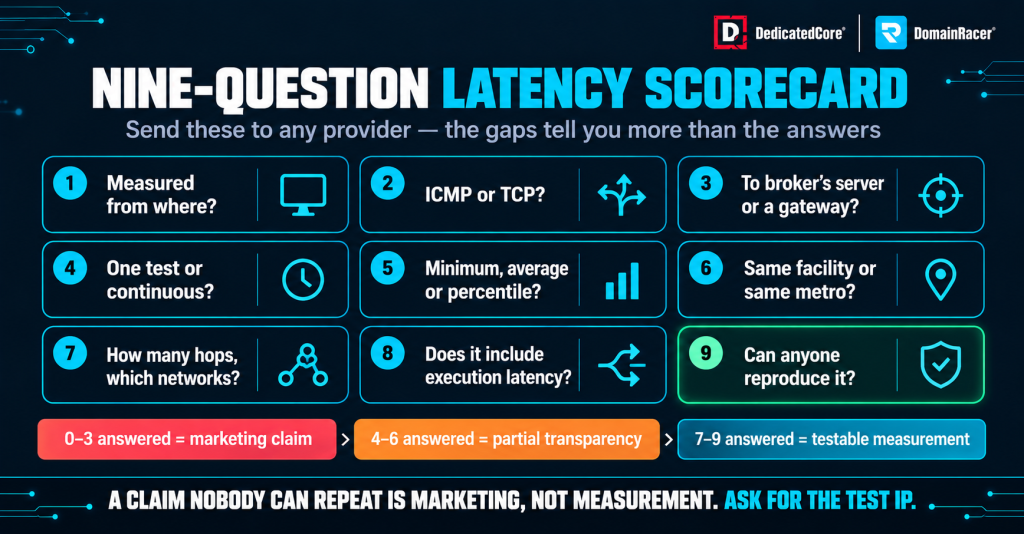
A nine-question scorecard for checking Forex VPS latency claims and separating marketing figures from reproducible measurements.
Ask these in order. A provider who answers all nine has given you something testable. After obtaining a provider’s measurement details, traders can use a broker round-trip test to compare the claim with latency to their own broker’s server.
- Measured from where? The VPS you would actually get, or a test box in a better rack.
- ICMP or TCP? Routers treat them differently, as the rate limit above shows.
- To the broker’s trading server, or to a gateway? Same building is not the same server.
- One test or continuous sampling? A single result describes a moment.
- Minimum, average, or percentile? The minimum is the most flattering number available.
- Same facility or same metro? Metro-level proximity is much weaker than it sounds.
- How many hops, and via which networks? Two providers in one building can route differently.
- Does it include execution latency? Everything after the broker’s gateway belongs to them.
- Can anyone reproduce it? Without a test IP, no.
Most providers answer only two or three questions. The real differences lie in how the number was measured. Question nine is the deciding factor: if nobody can repeat the test, it’s a marketing claim, not a reliable measurement.
Beyond Minimum Ping: Understanding Real-World Forex VPS Latency
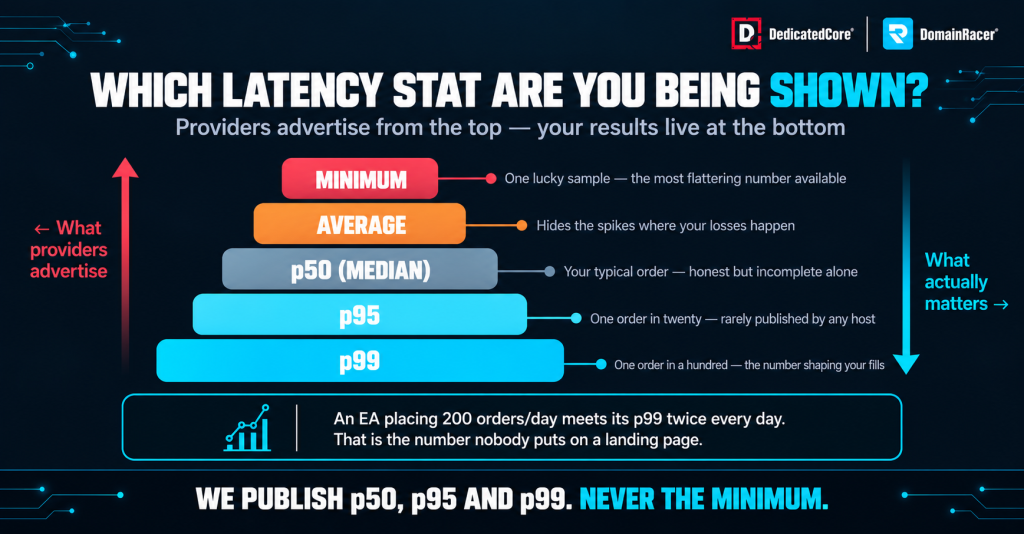
Forex VPS performance depends on p50, p95, and p99 latency—not just the minimum advertised figure.
The same route produces very different figures depending on which statistic you report.
| Statistic | What it describes | What it hides | Why it gets advertised |
| Minimum | The single best sample | Every sample that went badly | It is the smallest number available |
| Average | The middle of the range | Spikes, where losses happen | It sounds rigorous |
| p50 | The typical order | The tail | Honest, but incomplete alone |
| p95 | One order in twenty | The worst 5 percent | Useful, rarely published |
| p99 | One order in a hundred | Very little | Least flattering, most useful |
An EA placing two hundred orders a day meets its p99 twice every day. That is the number shaping your results, and it is the one nobody puts on a landing page.
We publish p50, p95, and p99, and never the minimum. The full definitions, set out in how ping, latency and timing differ, separate each figure from execution time.
A Defensible Forex VPS Latency Claim: The Evidence That Matters
Written out properly, a real claim reads like this.
“Median round-trip time of X ms from our LD4 nodes to [named broker] trading server, measured by TCP connect every 10 seconds over 30 days. p95 of Y ms, p99 of Z ms, jitter under J ms, packet loss under L percent. Test IP available on request.” To check whether a named endpoint belongs in the stated facility, traders can consult a broker data-centre lookup for broker-first facility reference information.
It is longer than “0.2ms latency” and less exciting. It is also checkable, which is the entire difference. When assessing London forex VPS latency, the London plan comparison provides the advertised configuration context, though route evidence still needs independent checking. DedicatedCore also offers trading plans with a 30-day trial and no setup fees, so traders can assess their hosting needs before committing.
Note what it does not claim. Nothing about execution speed, because that belongs to the broker’s matching engine. Nothing about your fills, because those depend on liquidity as well as timing. A provider promising faster execution is promising something they do not control.
Forex VPS Latency Testing: How to Measure Real Network Performance
Five steps, about ten minutes, and you can verify or dismiss any claim in this market.
- Find the broker’s login server address and port in your app. For MT4 or MT5, check the login information. For cTrader and NinjaTrader, find it in the settings.
- Perform a TCP connection test—not a website ping—to verify real connectivity.
- After an hour of running the test, keep track of the average speed, slowest speed, and fastest speed
- Then, run a traceroute to get the number of hops it takes to reach your target.
- Repeat during an open session, because a quiet-hour result tells you nothing about the times you trade.
Do this before you commit and again after any network change. A host that will not give you a test IP has answered the question without saying anything. You can also assess Forex VPS from DomainRacer by requesting a test IP and checking the route to your broker.
Forex VPS Latency Claims: Red Flags That Deserve a Closer Look
Certain phrases signal that a number was chosen rather than measured.
- A single figure with no endpoint — the most common one, and the least meaningful.
- “Up to” anything — describes a best case that may never repeat.
- Latency quoted alongside execution speed — mixes what the host controls with what the broker does.
- No jitter or packet loss figure — the two numbers that reveal stability, both absent.
- No test IP — the claim is designed not to be checked.
- A number that never changes — real routes vary, so a static figure means nobody is measuring.
Check this with any provider you use. Network routes can change at any time, so old latency figures may no longer be accurate. Continuous monitoring helps find out if higher latency comes from routing issues or attacks on the network path.
Forex VPS Latency Verification Through Our Real-World Examples
Our Forex VPS latency case studies show why changing providers does not always improve trading performance. We examine real-world routing paths, latency measurements, and broker locations to explain what actually affects execution speed and when a provider switch makes a difference.
Case Study 1 — A trader who switched providers and gained nothing.
Customer: A trader running a scalping EA who moved on the strength of a much lower advertised latency figure, then saw no change in fills.
Our solution: We measured both providers to the same broker endpoint using TCP connect rather than ping. The advertised difference disappeared. The old provider’s real path was shorter, and the new figure had been measured to a gateway rather than the broker.
The result: The trader moved back. The number was accurate and irrelevant, which is the hardest kind of claim to argue with.
Case Study 2 — Two claims, nine questions.
Customer: A trader comparing two providers, both claiming sub-millisecond latency to LD4, unable to tell them apart.
Our solution: We sent both the nine questions. One answered seven, named the endpoint, and supplied a test IP within an hour. The other answered two and described the rest as commercially sensitive. When two providers advertise similar sub-millisecond figures, traders can consult a broader set of selection criteria that cover performance, infrastructure, and support checks.
The result: The measurement confirmed what the response had already shown. Willingness to be tested is itself a data point.
Both cases turned on the same move. Nobody disproved a number, because the numbers were true. They just described something other than what the trader was buying.
DedicatedCore’s Expert Answers to Forex VPS Latency Claim Questions
We’re often asked whether advertised Forex VPS latency figures are genuine. Based on our experience with network routing and latency verification, we explain what a 0.2 ms claim actually means, how to verify it, and why broker location, routing paths, and real-world measurements matter.
Is a provider lying when they advertise 0.2ms latency?
We would not say lying, and we would not trust the number either. A 0.2ms round trip is real physics inside a single facility, so the figure is usually accurate for whatever the provider measured. The issue is that they rarely say what that was.
We publish the endpoint, the tool, the stat, and the sample size behind every figure. Those four details are what turn a real number into a meaningless one if they’re missing. Ask any provider for all four. A host that gives you clear answers is actually measuring something. A host that says the details are confidential is telling you, without saying it, that the number was just made up.
What should I ask a Forex VPS provider before I buy?
We think two questions do most of the work. Ask what the number was measured to, and ask for a test IP so you can repeat it yourself. Everything else follows from those.
If the answer names your broker’s trading server and includes an address you can test, you are dealing with a measurement. If it names a gateway, a metro area, or nothing at all, you are dealing with a marketing figure. The second answer takes one message to give, and almost nobody gives it.
Can I test a provider before I sign up?
We hand out test IPs on request, and we would tell any trader to ask every provider on their shortlist for the same. It costs us nothing, and it is the only way you can compare fairly.
Run a TCP connect test from your own machine to that address, then compare the result against the route your broker actually sits on. It will not be identical to what you get from inside the VPS, but it tells you the facility and the network are real. That is more than a landing page can prove.
Verify Before You Buy: Request the Forex VPS Test IP
Most latency numbers are real. The problem is that nobody says how they were measured, and a 30-day measurement routine shows what that disclosure looks like. Four details decide whether a figure means anything: the endpoint, the tool, the statistic, and the sample size. Without them, every provider looks the same.
So ask for the test IP first, and use an LD4 facility verification guide to decide where your server should sit. A provider who gives you one is inviting the check, and one who does not has already answered. DedicatedCore and DomainRacer share the method behind every figure and hand you the address to test it, with a 30-day trial and no setup fees. The full method is in our proximity and network measurement document.

