
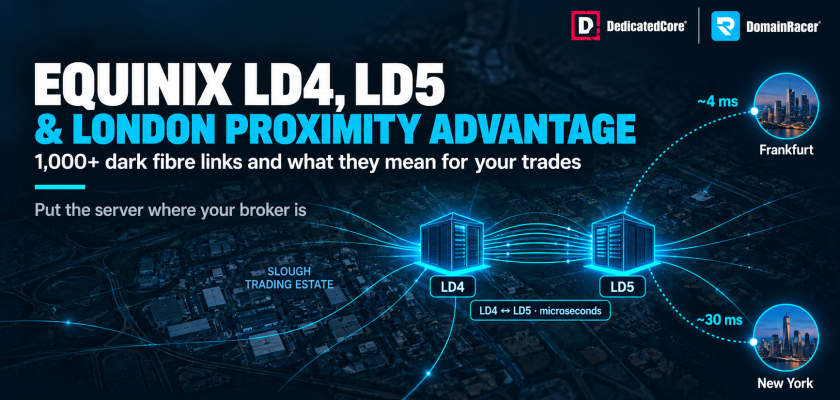
Equinix LD4 and LD5 sit on the same Slough trading estate, a few hundred metres apart on Buckingham Avenue. Between them, they anchor most of the electronic FX infrastructure in Europe. Equinix publishes the number that matters for anyone trading from there. The Slough campus reaches New York in about 30 milliseconds and Frankfurt in about 4. Those are floors, and no provider sells past them.
That one fact ends most proximity debates before they begin. DedicatedCore and DomainRacer treat location as a real physical limit, not a sales label. A server in the wrong building cannot be fixed to work like one in the right building. This guide shows what is inside LD4 and LD5, what proximity actually gives you, and how to check a claim.
The Rise of Slough in London’s Forex Liquidity Infrastructure
The obvious question is why the centre of European FX sits on an industrial estate west of Heathrow rather than in the City.
- Space and power. The Slough Trading Estate had both, at a scale central London could not offer in the mid-2000s.
- Transatlantic cable routes. The campus sits near the paths running west toward the Atlantic landing stations.
- First movers created gravity. LD4 opened in 2007, and exchanges followed. Every participant after that had to be where the others already were.
- Interconnection density. Equinix reports over 90 network service providers at the Slough campus. This is what allows direct cross-connects to happen.
That fourth point is the whole mechanism. A liquidity hub is not a building with fast internet. It is a place where enough counterparties already sit that reaching them becomes a cable rather than a route across the public internet.
Most hosts describe Slough as a location. It is closer to an address book.
Equinix LD4 vs LD5 vs Docklands: Forex VPS Location Comparison
Three London facilities get named in Forex VPS marketing, and they do different jobs.
| What matters to a trader | Equinix LD4 | Equinix LD5 | Docklands (LD8, Telehouse) |
| Opened | 2007 | Later campus expansion | 1990s onward |
| Primary role | Electronic trading venues | Trading and enterprise overflow | Carrier and peering hub |
| FX venue presence | Highest, including LMAX | Present, campus-connected | Limited |
| Connection to the other | 1,000+ dark fibre links to LD5 | Same, to LD4 | Separate metro, separate ecosystem |
| LINX access | Yes | Yes | Yes, and historically the core |
| Why a broker sits there | Proximity to matching engines | Campus proximity, more space | Network reach rather than trading |
| Why a trader sits there | Nearest to FX matching | Effectively equivalent | Wrong hub for most FX brokers |
That fourth row ends the LD4-versus-LD5 argument. When choosing between London facilities, traders can check where a broker’s server is hosted before weighing anything else in the path. The two buildings are joined by over a thousand diverse dark fibre links. As a result, the difference in their connection is measured in microseconds and is swamped by everything else in the path.
Inside Equinix LD4 and LD5: Forex Trading Infrastructure and Connectivity
Understanding the ecosystem explains why proximity is worth anything at all.
- Trading venues and exchanges, including FX multilateral trading facilities. LMAX moved into LD4 in late 2012, and BATS Chi-X made it a centre for European equities.
- Liquidity providers and banks, whose pricing engines feed the venues.
- Broker infrastructure, which is what your orders actually reach.
- Market data vendors, distributing prices to everyone else in the building.
- Network service providers, more than 90 on campus, making cross-connects possible.
Your broker’s matching engine, if it sits here, shares an ecosystem with the liquidity it draws on. That is what proximity buys. Not that your VPS is near a famous building, but that your broker’s gateway is near the venues it trades against.
Forex VPS Order Path From Trading Terminal to Liquidity Hub
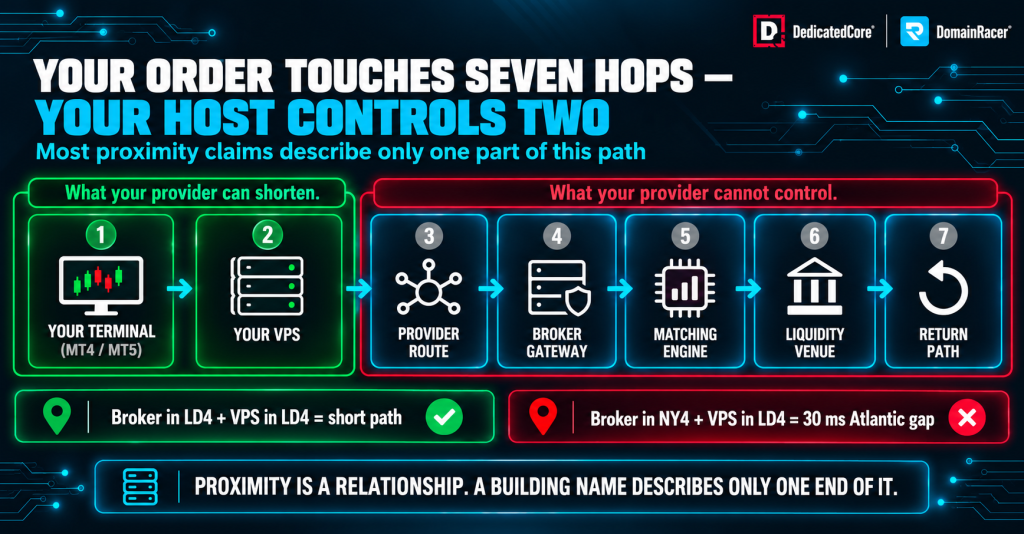
How VPS location and network routing affect Forex trading latency.
The path matters more than the postcode, and most proximity claims describe only one hop of it.
- Your terminal — MT4, MT5, cTrader, or NinjaTrader, running on the VPS.
- Your VPS — wherever it physically sits.
- The route out — your provider’s network and its peering.
- The broker’s gateway — the edge of their infrastructure.
- The broker’s matching engine — where your order fills.
- The liquidity venue — where the broker sources the price.
- The return path — confirmation, back through all of it.
A provider can only shorten the first two stages. An LD4 server is genuinely short if your broker matches in LD4 and pure distance if they match in New York. This is why we ask which broker you trade with first. We will not sell you a London VPS when your broker matches at NY4.
Equinix LD4 VPS Latency: What Determines Sub-Millisecond Performance
No, and the honest answer has five parts.
- A cross-connect inside one hall is genuinely sub-millisecond. The physics allows it.
- You are not cross-connected. A VPS reaches the broker over a network path, not a patch cable.
- Routing decides the rest. Two providers in the same building can take different paths out.
- Your broker may not be there. The same building as the venue is not the same as your broker.
- Execution latency is separate. Everything after your packet arrives belongs to the broker.
Forex VPS Latency Floors Between Major Trading Hubs
These are physical distances rather than provider figures, so no host beats them. Once physical latency floors are understood, traders can work through the remaining provider checks before purchase when comparing VPS providers.
| Origin hub | Target hub | Baseline floor | What it means for you |
| Slough (LD4/LD5) | Frankfurt (FR2) | ~4 ms | Workable for European cross-matching strategies |
| Slough (LD4/LD5) | Secaucus (NY4) | ~30 ms | Do not host in LD4 if your broker matches at NY4 |
| LD4 | LD5 | Microseconds | Campus-connected by 1,000+ dark fibre links |
Those first two figures are Equinix’s own, published about its own campus, and the questions in what a latency figure actually means turn any rival claim into something checkable. Any host quoting better is contradicting its landlord. A sub-millisecond claim is achievable and rarely verifiable. That gap is the real problem.
Forex VPS Proximity Explained: Seven Types and What You Can Verify
Providers use one word for seven different things. Only three of them can be checked.
- Same building — verifiable, via facility name and a test IP.
- Same campus — verifiable, and effectively equivalent for FX.
- Same metro — verifiable, and much weaker than it sounds.
- Same country — marketing.
- Near the exchange — meaningless without a measured route.
- Low-latency to LD4 — unverifiable unless they name the endpoint.
- Cross-connected — real and rare, and rarely what a VPS buys.
The first three you can confirm. The rest need a measurement, and the gap between a ping versus an endpoint test is where most proximity claims quietly fail. To distinguish a nearby gateway from a useful trading endpoint, traders can use a latency test to the broker to organize the measurement against the broker’s actual server.
We state the facility and hand you a test IP. A provider that won’t do both is selling you a claim, not a location. Comparing hosts? Look at DomainRacer Forex VPS; check the server location first. Then check the route to your broker. Do both before you choose a plan.
Forex VPS Location Selection Based on Broker Server Region
Location follows the broker, not the trader. Where you live is irrelevant.
| Your broker matches at | Put the VPS in | Typical brokers present | What to verify |
| London LD4 or LD5 | Slough campus | UK and EU-regulated FX brokers | Route stays on-campus, no London detour |
| New York NY4 | Secaucus | US brokers, many ECNs | No transatlantic hop in the traceroute |
| Tokyo TY3 | Tokyo | Asian sessions, JPY pairs | Direct path, not routed via Singapore |
| Singapore SG1 | Singapore | Southeast Asian brokers | Regional peering rather than a US return |
| Frankfurt FR2 | Frankfurt | Some EU brokers, EUR pairs | Under 5 ms to Slough if you also trade UK |
Equinix’s own figures show why guessing is expensive. When the broker endpoint is in London, the London plan comparison sets out the configurations to assess against that account server. Slough reaches Frankfurt in roughly 4 milliseconds and New York in roughly 30. Put a scalping EA on the wrong side of that Atlantic gap and no clock speed or NVMe recovers it. For traders choosing a server region around their broker’s location, DedicatedCore also offers trading plans across broker regions as an option.
Before placing a scalping EA across a transatlantic route, traders can use a broker-matched region suggestion to organize the location decision around the broker’s trading server.
Equinix LD4 and LD5 Verification: DedicatedCore Eight-Point Proximity Checklist
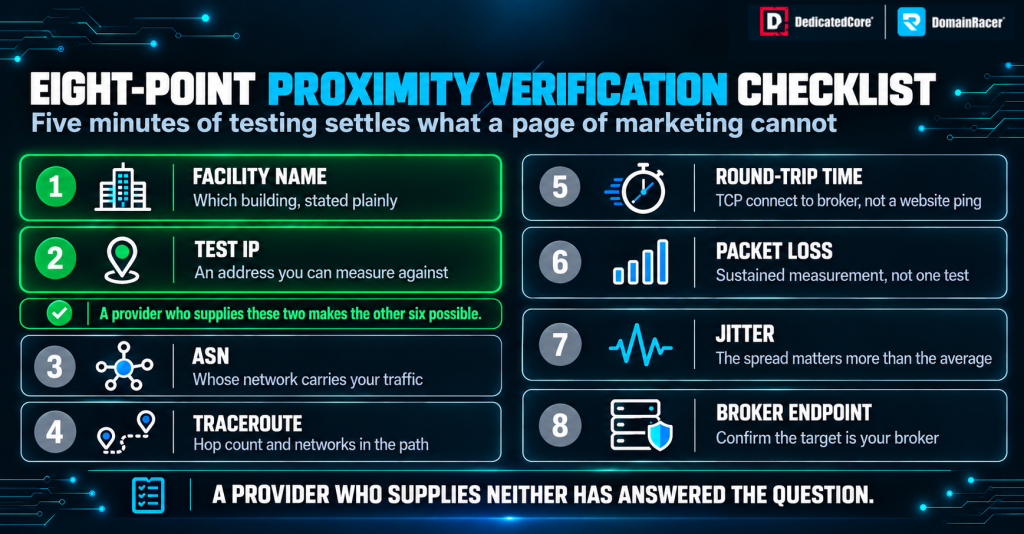
DedicatedCore’s eight-point checklist for verifying Forex VPS proximity, broker connectivity, and real-world network latency.
Run this before believing any proximity claim, including ours.
- Facility name. Which building, stated plainly. LD4, LD5, or something else.
- Test IP. An address in that facility you can measure against.
- ASN. Whose network is carrying your traffic.
- Traceroute. Hop count and the networks in the path.
- Round-trip time. TCP connect to your broker’s trading server, not a ping to a website.
- Packet loss. Sustained measurement, not a single test.
- Jitter. The spread, which matters more than the average for scalping.
- Broker endpoint. Confirmation that the measurement targeted your broker.
Five minutes of testing settles what a page of marketing cannot. A provider who supplies the first two makes the other six possible, and one who supplies neither has answered the question.
Financial Trading Hubs and the Security Risks of Infrastructure Concentration
Concentration cuts both ways, and the trading hubs know it.
The same density that makes LD4 valuable also makes financial infrastructure one of the most attacked verticals there is. Trading platforms get targeted during volatile market hours. This is because timing is the essential product in trading.
- Proximity does not protect you. Being near the venue means nothing if the path to it is saturated.
- Volumetric attacks hit the route, not the building.
- Session hours are when it happens, because that is when it costs.
Location and protection are separate needs. Our DDoS attack case study collection shows record-breaking attacks and current traffic levels. A low-latency route without DDoS filtering can still leave your server unreachable. When you outgrow virtualization, consider DedicatedCore dedicated servers. We assess server options based on your network routing and DDoS protection needs.
Forex VPS Proximity Outcomes Through Our Real-World Examples
We regularly test how server location affects real-world Forex trading latency. These case studies show why the right data center matters. Real network routes decide it, and measured latency does too. The building’s location does not.
Case Study 1 — Same building, worse latency.
Customer: A trader comparing two providers, one in LD4 and one in a nearby facility, finding the LD4 server measurably slower to their broker.
Our solution: We ran traceroutes from both. The LD4 provider’s traffic left the campus, crossed a peering point in central London, then came back. The other provider held it on-campus. Same postcode, different route.
The result: Proximity was never the variable. Routing was, and the building name had concealed it.
Case Study 2 — A London server for a New York broker.
Customer: A trader running a scalping EA on an LD4 VPS, with a broker whose matching engine sits at NY4, seeing consistent slippage on entries.
Our solution: We checked the broker’s trading server location before touching anything else. The order path crossed the Atlantic twice per round trip, against Equinix’s own 30-millisecond floor.
The result: Moving the VPS to Secaucus removed the transatlantic leg. The London server had been the problem, not the fix. Before relocating a VPS to remove an unnecessary transatlantic leg, traders can follow a step-by-step server transfer checklist to plan the move and verify the new environment.
Both cases show the same thing. Proximity is a relationship between your server and your broker, and a building name describes only one end of it.
DedicatedCore’s Expert Answers to Equinix LD4 and LD5 Questions
We’re often asked whether Equinix LD4 or LD5 is better for a Forex VPS. We work with trading infrastructure and network routing every day. The right choice depends on your broker’s server location, network path, and measured latency—not just the data center name.
Is LD4 better than LD5 for a Forex VPS?
We treat them as one campus, because Equinix effectively built them that way. The two buildings connect with over a thousand dark fibre links. This means the latency difference is just in microseconds, lost among everything else on your path.
Providers marketing LD4 as premium over LD5 are selling a distinction that does not survive measurement. What matters is whether your broker’s matching engine sits on that campus at all, and what route your traffic takes to reach it. We would rather place you in LD5 with a clean on-campus route than in LD4 behind a path that leaves and returns.
How do I know my provider is really in LD4?
We give you the facility name and a test IP, and we would tell any trader to demand both before paying. With those two, you can run a traceroute, check the ASN, and measure round-trip time to your own broker’s server. Without them, an LD4 claim is unverifiable by design.
The tell is what happens when you ask. A provider genuinely there answers in one message, because the information costs them nothing. The reason the details are confidential is due to a reselling capacity elsewhere, and that’s the answer.
Should I choose my VPS location based on where I live?
We ask where your broker matches, not where you sit, because your own connection to the VPS has almost nothing to do with execution. You connect over RDP to look at charts. Your EA runs on the server and talks to the broker without you.
So a trader in Mumbai with a UK-regulated broker wants a Slough server, and a trader in London with a US broker wants Secaucus. Your latency to the VPS decides how smoothly charts scroll. Your VPS latency to the broker decides your fills.
Put the Server Where Your Broker Is
Slough became a liquidity hub. Enough counterparties came together, making cross-connects worthwhile. Equinix’s own figures, 30 milliseconds to New York and 4 to Frankfurt, define floors no provider beats. Being in LD4 is worth something only if your broker is there too. Proximity sits next to a plan’s CPU and memory sizing and the measurement method that proves it. The building name is the easiest to claim without proof.
So start with your broker’s trading server address, then pick a region, then ask for a facility name and a test IP. DedicatedCore and DomainRacer list the facility, provide a test address, and tell you when a different region suits your broker better, with a 30-day trial and no setup fees. Put the server where your broker is, because every other optimisation depends on that.

