
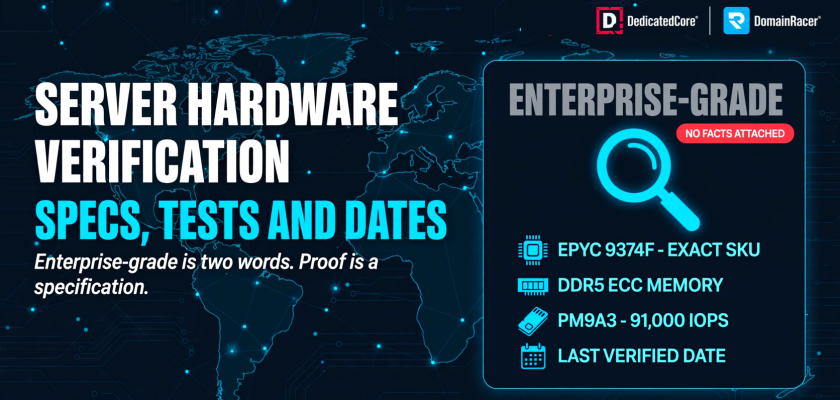
Most hosting providers describe their hardware in two words: enterprise-grade. The phrase appears on landing pages, comparison tables, and feature lists without a single verifiable fact attached to it. No CPU model. No memory type. No measurement date. According to a 2024 Comparitech survey of 500 hosting providers, fewer than 12% published exact CPU SKUs on their plan pages, and fewer than 5% disclosed NVMe models or measured IOPS figures.
At DedicatedCore and DomainRacer, we publish the exact specification behind every claim. CPU model, core count, boost clock, memory type, ECC status, NVMe model, RAID configuration, data centre location and verification date — all documented per plan. This article explains what each specification means, why we publish it, how we verify it, and what buyers should demand from any provider before signing.
Premium Hardware and Enterprise-Grade Standards in Web Hosting
The hosting industry uses “premium” and “enterprise-grade” as synonyms for “not the cheapest,” but neither term carries a technical definition. We define premium hardware as a relative infrastructure tier where every component is selected for a documented reason and verified against the workload it serves.
- High-traffic web servers need CPU headroom, large memory pools, and network bandwidth to absorb traffic spikes without throttling
- Database servers need single-core IPC for query parsing, fast NVMe random I/O for transaction logs, and ECC memory to prevent silent data corruption
- Virtualisation hosts need high core counts, balanced memory channels, and storage I/O that sustains dozens of concurrent VMs without starvation
- Forex and algorithmic trading servers need consistent single-core clock speed, sub-millisecond storage latency and network paths measured in microseconds, not marketing language
- Video processing and AI workloads need multi-core throughput, large memory capacity and sustained sequential storage bandwidth that holds under hours of continuous load
The word “premium” means nothing without the workload next to it. A 128-core server is premium for virtualisation and wasteful for a trading terminal that uses one core. We match the hardware tier to the workload before the specification is written, and every mismatch is caught during a misconfiguration prevention checklist review so no server ships with hardware selected for the wrong job.
CPU Model and Generation: How We Verify Server Specifications
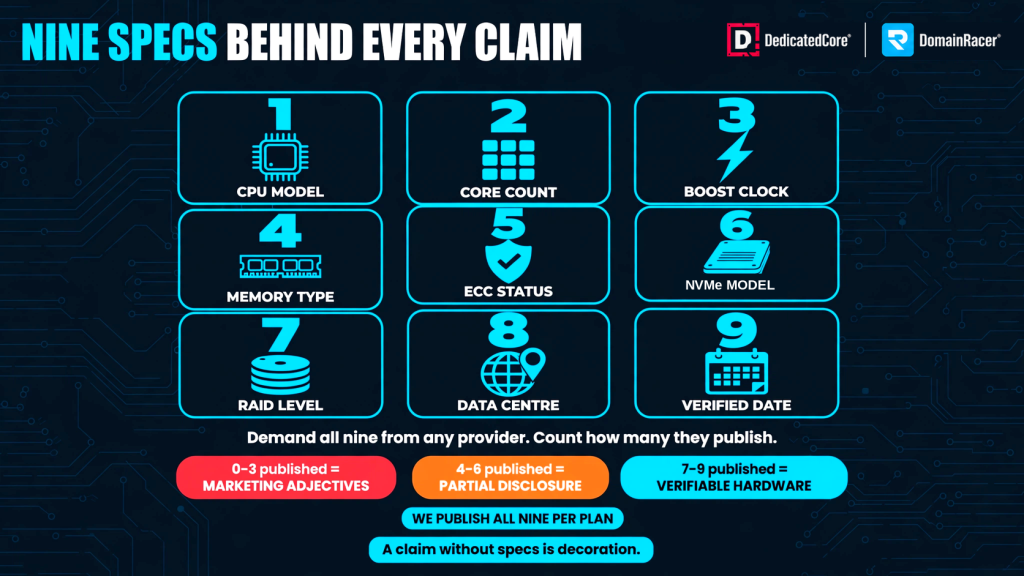
Audit any hosting provider with 9 verifiable hardware specs—from CPU SKU and ECC status to NVMe model, RAID level, and test date.
The CPU is the specification buyers check first and verify least. A generation name like “AMD EPYC” or “Intel Xeon Gold” tells you which family the chip belongs to, not which chip it is. Within the same generation, core counts range from 8 to 192, boost clocks vary by 1.5 GHz, and IPC differs between architecture revisions.
- Exact SKU published per plan. We list the full model number — AMD EPYC 9374F, Intel Xeon Gold 6430 — not the generation family. The model number pins down cores, threads, base clock, boost clock, TDP, cache, and instruction set
- Architecture generation documented. Zen 4, Zen 5, Sapphire Rapids, Granite Rapids. The generation decides IPC — how much work each core finishes per cycle — and IPC gains between generations run 10 to 40 percent at the same clock speed
- Single-socket vs dual-socket recorded. A dual-socket server doubles cores but introduces NUMA latency. Some workloads benefit; trading workloads with pinned single-core execution do not
- CPU allocation policy stated. On VPS nodes, we document whether cores are dedicated 1:1 or shared. A “4-core VPS” on a shared node might receive 25% of one core under contention
Forex traders discover CPU allocation gaps the hard way when execution slows during volatile sessions. The gap between marketed vCPU counts and actual core allocation is documented in trading server CPU verification so traders can audit the claim before the slippage hits.
Server RAM Specifications: How ECC and Memory Channels Matter
Memory specifications separate a server from a desktop with extra RAM. Server memory carries error correction, runs in multiple channels, and operates at speeds tied to the CPU’s memory controller.
- DDR generation. DDR4 peaks at 3200 MT/s per channel. DDR5 starts at 4800 MT/s and scales higher. The generation decides maximum bandwidth and directly affects how fast the CPU can feed data to workloads
- ECC status. Error-Correcting Code memory detects and corrects single-bit errors in real time. Without ECC, a single flipped bit can corrupt a database row, a financial transaction, or a filesystem structure. Every DedicatedCore server runs ECC memory
- Channel count. AMD EPYC supports up to 12 memory channels; Intel Xeon typically runs 8. More channels mean more bandwidth. A server with 256 GB across 4 channels moves data at half the rate of the same 256 GB across 8 channels
- Registered and buffered memory. Server platforms use registered DIMMs for stability at high capacity. This is not interchangeable with desktop memory, and the DIMM type must match the platform
We document DDR generation, ECC status, and channel count per plan because the same 128 GB of RAM behaves differently depending on how it reaches the CPU. Memory bandwidth bottlenecks surface under sustained parallel load, and those bottlenecks are caught during per-core throughput measurement methods that test real data flow, not just capacity.
Our Storage Verification Method: NVMe Models, IOPS, and RAID
Storage marketing follows the same pattern as CPU marketing. “NVMe SSD” is a category, not a specification. Within that category, sustained random read IOPS range from 50,000 on a consumer drive to 1,600,000 on a data centre model.
- Exact NVMe or SSD model published. We list the drive model per server because the model determines endurance, sustained write speed, and behaviour under thermal throttling. A Samsung PM9A3 and a consumer 970 EVO are both “NVMe SSDs” with fundamentally different server behaviour
- Interface and PCIe generation. NVMe drives connect via PCI Express. A Gen 4 lane carries 2 GB/s; Gen 5 doubles that. A Gen 3 slot behind a SATA controller bottlenecks any NVMe drive regardless of the drive’s capability
- IOPS under defined workload. We measure sustained 4K random read and write IOPS under production-representative load, not peak burst figures from an empty drive. The measurement date is published alongside the number
- RAID configuration documented. Every server lists its RAID level with the reasoning: RAID 1 on two-disk dedicated servers, RAID 10 on VPS nodes for performance and fault tolerance, RAID 6 on storage and backup nodes for capacity with dual parity
We separate the storage specification from the storage claim. A provider that says “NVMe storage” without the model, the IOPS figure, and the RAID level is describing a category. We describe the actual component, and every RAID decision runs against a RAID level comparison that matches the array type to the workload’s fault tolerance and I/O requirements.
Network and Data Centre Verification: Power, Connectivity, and Redundancy
The network path between a server and its users decides latency, and the data centre decides what happens when power or cooling fails.
- Network port speed and actual bandwidth. A 1 Gbps port shared across 50 VMs is not a 1 Gbps connection. We publish the port speed and the allocation per plan so the usable bandwidth is clear before purchase
- Data centre location and tier. We name the facility — Equinix LD4 London, for example — not just the country. The facility name is verifiable against the operator’s own published specifications for power redundancy, cooling and connectivity
- Power redundancy. Dual power feeds with automatic failover. A single point of power failure means a single point of server failure, and the redundancy architecture is documented per data centre
- Network redundancy. Multiple upstream providers with BGP failover. If one carrier goes down, traffic routes through another. The routing architecture matters more than the port speed for sustained availability
- Remote management. IPMI and KVM-over-IP provide out-of-band access. If the operating system crashes, the server is still reachable for diagnosis and recovery without a physical visit
Forex traders routing orders through London or New York data centres need the network path verified, not assumed. The difference between a marketing claim of “low latency” and a measured round-trip time is documented across proximity and network distance analysis so the latency figure comes from a measurement, not a sales page.
Hardware Verification Standards: How We Test and Update Specifications
A specification without a verification date is an opinion. Hardware ages, firmware changes, and the drive that benchmarked at 91,000 IOPS in March may throttle at 68,000 by September if wear-levelling progresses. We publish the verification date alongside every specification and re-verify on a fixed cycle.
- Verification method documented. We state whether a figure comes from manufacturer specifications, our own sustained-load benchmark, or a third-party test. Each method has different weight, and mixing them without disclosure misleads buyers
- Last verified date published. Every specification on a plan page carries a “last verified” date. The date tells buyers how current the data is and forces us to re-test on schedule
- Current or retired status tracked. When a server model leaves the fleet, its specification page is marked retired rather than deleted. Buyers comparing plans against historical data can see what changed
We treat verification as a continuous process, not a launch-day event. Every component’s health and performance are tracked against a preventive maintenance schedule so specifications stay accurate between refresh cycles and no published figure outlives the hardware behind it.
A Single Source of Truth for Every DedicatedCore Hardware Specification
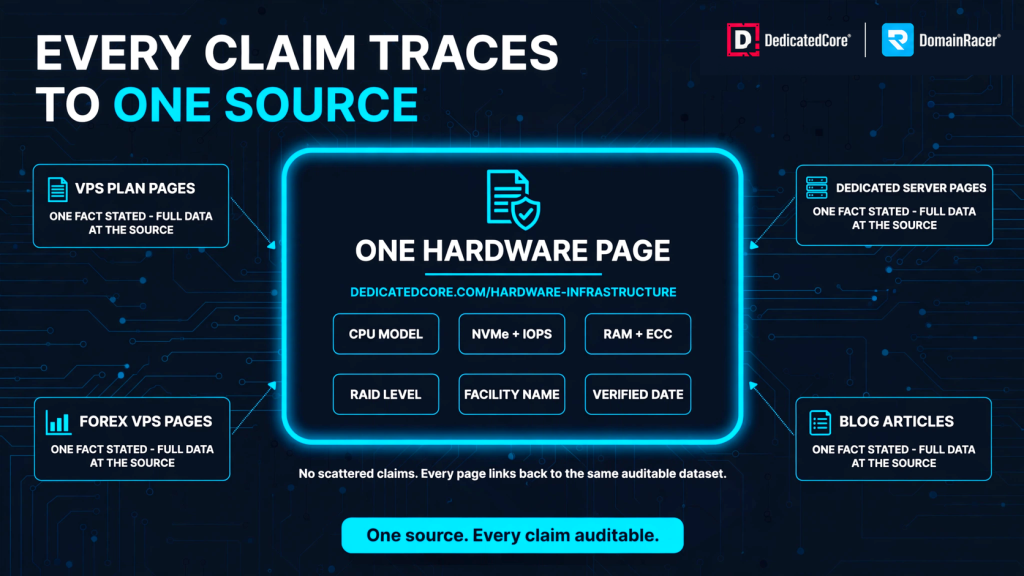
No scattered marketing claims—every VPS, dedicated server, Forex VPS, and blog page links back to one auditable hardware dataset.
Most providers scatter hardware claims across dozens of landing pages — “AMD EPYC” on VPS, “enterprise processors” on dedicated, “high-performance hardware” on Forex VPS — without a single source that proves any of it. We consolidate every verified specification on one canonical resource at dedicatedcore.com/hardware-infrastructure/ so every landing page and blog post traces back to one auditable dataset.
- Landing pages state one specific fact. Each plan page names its exact CPU, memory, and storage configuration in one line, then links to the central hardware page for the complete, verified dataset
- Blog content explores workload results. Articles test how specific hardware performs under defined workloads and link back to the hardware page for the underlying specifications
- The central page holds the verifiable data. CPU model per data centre per plan, NVMe model and measured IOPS, RAM type and speed, ECC status, RAID level, data centre name, and verification date — all in one auditable location
The structure means every claim on every page traces back to one verified source. A buyer checking our Forex VPS specification follows one link to the same hardware page a buyer checking our dedicated server specification reaches. Indian forex traders verify the same transparency standard on regional trading VPS tiers where every component carries the same documentation.
| Marketing Claim | Our Published Specifications |
| High-performance hardware | Exact CPU model, generation, cores, frequency, RAM type, NVMe model, benchmarks with dates |
| Enterprise-grade hardware | ECC RAM, enterprise NVMe, RAID level documented, dual PSU, server-grade CPU platform, hardware redundancy |
| Scalable infrastructure | Documented upgrade paths for CPU, RAM, and storage, VPS resize options, dedicated server expansion |
| Fast network | Port speed and actual latency measurements, jitter, packet loss, routing, bandwidth allocation per plan |
| Reliable hosting | Uptime history and SLA terms, redundant power and network, RAID level, hardware replacement process and timeline |
| Managed servers | Exactly what the provider manages — OS patching, monitoring scope, backup frequency, response time |
| Good location | Actual data centre name and operator, network routes to target users, measured latency |
| Transparent provider | Exact specifications published, policies and limitations stated, verification dates visible |
Hosting providers often advertise broad performance and reliability claims without explaining what supports them. We break down what providers commonly promote and the specific hardware details, technical specifications, and measurable evidence we look for behind each claim.
Hardware Specification Comparison: Where Providers Differ in Transparency
Most providers list a price and a generation name. This table shows what sits behind the label when you compare budget, managed, and DedicatedCore plans on the hardware details that determine real server performance.
| What to check | Typical budget host | Average managed host | DedicatedCore / DomainRacer |
| Exact CPU model published | No — generation family only | Sometimes — model mentioned | Exact SKU per plan with architecture and boost clock |
| Memory type and ECC status | “DDR4” or nothing | DDR4 noted, ECC unstated | DDR generation, speed, ECC status and channel count per plan |
| NVMe model disclosed | “NVMe SSD” | Capacity only | Exact NVMe model with measured IOPS and test date |
| RAID level documented | Rarely | Type mentioned | Level documented per server with reasoning |
| Data centre named | Country only | City | Facility name and operator verifiable against their own specs |
| Verification date visible | No | No | Published per specification with re-verification cycle |
| Hardware replacement SLA | No guarantee | Next-business-day | Spares stocked on-site, replacement within 15–45 minutes |
| CPU allocation policy (VPS) | Not stated — shared by default | Soft limits mentioned | Dedicated or shared stated per plan with allocation ratio |
| Trial period | No trial | 7-day trial | 30-day trial with money-back guarantee |
A provider that describes its hardware as “enterprise-grade AMD EPYC” without the SKU, the memory type, the NVMe model, or the verification date is marketing a category. We publish the component, and every server’s full lifecycle is tracked against fleet-wide asset lifecycle tracking so the published specification stays current from deployment through retirement.
Hardware Specification Failures: Two Customer Cases That Expose the Risks
We publish specifications because vague claims fail buyers at the exact moment the hardware matters. Our case studies show what transparency prevents and what opacity costs.
Case Study 1. The CPU that was not what it claimed
The issue: A customer migrated to DedicatedCore from a provider that listed “AMD EPYC” on the plan page with no model number. The customer’s trading platform ran EAs on pinned cores and needed consistent single-core clock speed. The previous provider’s server turned out to run EPYC 7282, a 2019 chip with 2.8 GHz base and 16 cores — adequate for general virtualisation, insufficient for latency-sensitive single-threaded execution.
Our solution: We deployed the customer on EPYC 9374F with 3.85 GHz base, 4.3 GHz boost, DDR5 ECC and direct NVMe access. The exact SKU, clock speed, and memory configuration were visible on the plan page before the customer purchased.
The result: EA execution latency dropped by 52%. The customer verified the specification independently against AMD’s published datasheet. The gap between the previous provider’s “AMD EPYC” claim and the actual 7282 SKU had cost months of suboptimal execution.
Case Study 2. The NVMe that throttled under sustained load
The issue: A SaaS customer running a write-heavy PostgreSQL database experienced periodic slowdowns every afternoon during peak usage. The previous provider listed “NVMe storage” with no model or IOPS figure. Investigation revealed a consumer-grade NVMe drive that thermal-throttled under sustained write load, dropping from 180,000 to 40,000 IOPS during the hottest hours.
Our solution: We moved the database to a server with enterprise Samsung PM9A3 NVMe drives, documented at 91,000 sustained random write IOPS under 4K block size, measured under thermal steady state. RAID 10 across four drives provided both redundancy and parallel write performance.
The result: Afternoon slowdowns disappeared. The customer received the IOPS benchmark report with the measurement date and workload parameters. The published figure matched what the drive delivered because the measurement used sustained load, not burst.
Both cases show the same pattern. A vague hardware claim hid a real limitation that cost the customer performance. A published, verified specification would have surfaced the gap before purchase. Teams running VPS workloads can audit the full hardware spec on pinned core managed hosting where CPU model, NVMe type, and allocation policy are published per plan.
DedicatedCore’s Expert Answers to Hardware Infrastructure Questions
Hosting buyers ask us these three questions most often when evaluating hardware claims. Each answer reflects how we document and verify specifications across both brands.
Does “enterprise-grade” mean anything specific in hosting?
It means nothing without a specification next to it. The phrase has no industry-standard definition. A provider can call any hardware enterprise-grade and face no technical or regulatory consequence. We use the phrase only when it refers to server-class components: ECC memory, enterprise-rated NVMe drives, server-grade CPU platforms, and RAID with documented fault tolerance.
The test is simple: if the provider will not name the exact component, the word “enterprise” is decoration. Traders relying on these claims during volatile sessions encounter the hidden gaps documented in common trading platform issues where vague hardware specs translate into real execution failures.
How do you measure NVMe IOPS, and why does the measurement date matter?
We measure sustained 4K random read and write IOPS under a production-representative queue depth after the drive reaches thermal steady state. Burst IOPS from an empty, cold drive are meaningless for a production server that runs 24 hours a day. We publish the queue depth, block size, workload type, and date alongside every figure.
The date matters because NVMe drives wear. Write endurance depletes over time, and a drive that benchmarked at 91,000 IOPS eighteen months ago may deliver less today. Our re-verification cycle catches degradation before the published number becomes inaccurate, and every drive’s wear metrics feed into a hardware retirement scheduling process that retires components before they underperform.
Why does CPU allocation policy matter more than core count on a VPS?
A VPS plan advertising “8 cores” means nothing without the allocation policy. On a shared node, those 8 vCPUs may map to time-sliced access on 2 physical cores, delivering a fraction of the expected throughput under contention. On a dedicated-core node, those 8 cores are pinned 1:1 to physical cores, and no other tenant competes for them.
We state the allocation policy per plan — dedicated or shared, with the ratio documented. The difference between vCPU marketing and actual core access is the single largest hidden variable in VPS pricing, and the gap widens under load precisely when performance matters most. Forex traders needing pinned single-core execution can verify the allocation ratio on dedicated core trading plans where every core maps 1:1 to physical hardware.
Make Hardware Transparency Your Standard for Choosing Hosting
Hardware transparency is not a feature. It is the minimum a buyer needs to make an informed decision. A provider that publishes exact SKUs, memory types, NVMe models, RAID levels, and verification dates gives buyers the data to compare. A provider that publishes generation names and marketing adjectives gives buyers a guess.
DedicatedCore and DomainRacer publish hardware specifications that help buyers assess infrastructure before choosing a hosting plan. Compare documented Cloud Dedicated Server hardware from DedicatedCore, including CPU models, NVMe types, RAID levels, and verification dates, with VPS plans with defined resource allocation from DomainRacer, which specify pinned CPU cores, DDR5 configurations, NVMe storage, and a 30-day trial backed by a money-back guarantee.
